How Does a Roth 401(k) Work? A Beginner’s Guide
 Written by
Karen Doyle
Written by
Karen Doyle
 Edited by
Nupur Gambhir, CFHC™
Edited by
Nupur Gambhir, CFHC™
Commitment to Our Readers
GOBankingRates' editorial team is committed to bringing you unbiased reviews and information. We use data-driven methodologies to evaluate financial products and services - our reviews and ratings are not influenced by advertisers. You can read more about our editorial guidelines and our products and services review methodology.

20 Years
Helping You Live Richer

Reviewed
by Experts

Trusted by
Millions of Readers
A Roth 401(k) is a workplace retirement account that lets you contribute after-tax dollars today in exchange for tax-free withdrawals in retirement. In other words, you pay taxes on your contributions now, but your qualified withdrawals — including investment growth — are generally tax-free later.
Like a traditional 401(k), a Roth 401(k) is offered through your employer and allows you to invest for retirement through payroll deductions. The key difference is when you pay taxes. Understanding how Roth 401(k) contributions, employer matches and withdrawal rules work can help you decide whether it’s the right retirement strategy for your long-term financial goals.
How a Roth 401(k) Works
A Roth 401(k) is like a mix between a traditional 401(k) and a Roth IRA. You contribute after-tax dollars, meaning you’ve already paid taxes on that money. In return, your money grows tax-free and when retirement withdrawals, you won’t owe a dime on your contributions or earnings — as long as you follow the rules.
Key Features of a Roth 401(k)
A Roth 401(k) lets employees contribute after-tax money to a workplace retirement plan that can grow tax-free and provide tax-free withdrawals in retirement.
- After-tax contributions. You contribute money that has already been taxed, so there’s no upfront tax deduction.
- Tax-free growth. Investment earnings grow tax-free as long as withdrawal rules are met.
- Employer matching. Employer matches are usually deposited into a traditional 401(k) portion and taxed later.
- No income limits. High earners can contribute, unlike with Roth IRAs.
Benefits of a Roth 401(k)
A Roth 401(k) offers several advantages for retirement savers who prefer paying taxes now in exchange for tax-free income later.
- Tax-free withdrawals in retirement. Because contributions are made with after-tax dollars, qualified withdrawals — including investment earnings — are generally tax-free in retirement.
- No required minimum distributions if rolled into a Roth IRA. Traditional 401(k)s require withdrawals starting at age 73. But if you roll a Roth 401(k) into a Roth IRA, you can avoid required minimum distributions and allow your savings to keep growing tax-free.
- Potential estate planning benefits. A Roth 401(k) can help pass tax-free assets to heirs. Beneficiaries typically do not owe taxes on withdrawals if they follow the required distribution rules.
- No income limits to contribute. Unlike Roth IRAs, which restrict contributions at higher income levels, Roth 401(k)s have no income limits as long as your employer offers the plan.
How Much Can You Contribute to a Roth 401(k) in 2026?
The IRS sets annual limits on how much you can contribute to workplace retirement plans. For 2026, the contribution limits for a Roth 401(k) are:
- Under age 50: Up to $23,500 per year
- Age 50 and older: Up to $31,000 per year, which includes a $7,500 catch-up contribution
These limits apply to your total 401(k) contributions, whether you choose Roth, traditional or a mix of both.
For instance, if you contribute $10,000 to a Roth 401(k) and $13,500 to a traditional 401(k) in 2026, you’ve reached the $23,500 annual limit.
Who Can Open a Roth 401(k)?
Anyone can contribute to a Roth 401(k) as long as their employer offers the option. Unlike a Roth IRA, there are no income limits, which means high earners can still participate.
The main requirement is that your workplace retirement plan includes a Roth 401(k) feature. Not all employers offer it, so check with your HR department or plan administrator to see if it’s available through your company’s 401(k) plan.
How to Open a Roth 401(k)
If your employer offers a Roth 401(k), here’s how to get started:
- Check with Your Employer. Confirm if a Roth 401(k) is available as part of your benefits package.
- Sign Up Through Your Workplace. Enroll via your HR or benefits portal.
- Decide on Your Contribution Amount. Choose how much of your paycheck to contribute.
- Select Your Investments. Most 401(k) plans offer mutual funds, index funds and target-date funds as investment options.
- Monitor & Adjust. Review your contributions and investments annually to ensure you’re on track for retirement.
How Roth 401(k) Withdrawals Work
A Roth 401(k) allows you to withdraw money in retirement tax-free, but only if certain rules are met.
Qualified Withdrawals (Tax-Free)
Withdrawals are generally tax-free if you meet both of the following requirements:
- You are at least age 59½
- You have held the account for at least five years
If both conditions are satisfied, you can withdraw both contributions and investment earnings without paying taxes.
Early Withdrawals (Taxes and Possible Penalties)
Taking money out early can trigger taxes and penalties.
If you withdraw earnings before age 59½ or before the five-year rule is met, you may owe income taxes plus a 10% early withdrawal penalty.
However, because Roth 401(k) contributions are made with after-tax dollars, the contributions themselves can generally be withdrawn without additional taxes or penalties.
Roth 401(k) vs. Other Retirement Accounts
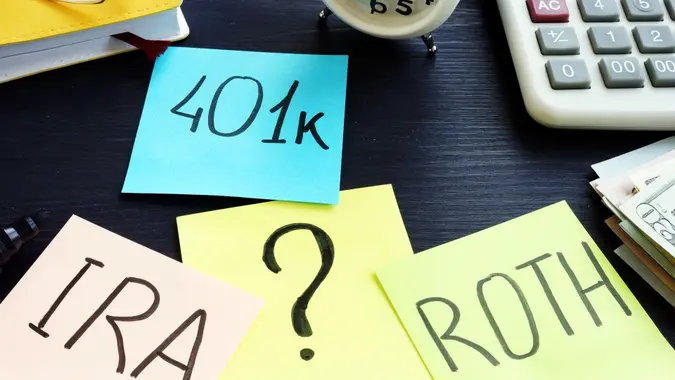
Retirement accounts can look similar at first glance, but the tax treatment, contribution limits and withdrawal rules can vary significantly. Understanding these differences can help you choose the account that best fits your retirement strategy.
Roth 401(k) vs. Traditional 401(k)
Both accounts are offered through employers and share the same contribution limits, but they differ in when you pay taxes.
| Feature | Roth 401(k) | Traditional 401(k) |
|---|---|---|
| Contributions | After-tax | Pre-tax |
| Withdrawals in retirement | Tax-free if rules are met | Taxed as ordinary income |
| Required minimum distributions | Yes, unless rolled into a Roth IRA | Required starting at age 73 |
| Best for | Those expecting higher taxes in retirement | Those who want a tax break today |
Roth 401(k) vs. Roth IRA
While both accounts offer tax-free withdrawals in retirement, they differ in eligibility rules and contribution limits.
| Feature | Roth 401(k) | Roth IRA |
|---|---|---|
| 2026 contribution limit | $23,500 ($31,000 if age 50+) | $7,000 ($8,000 if age 50+) |
| Income limits | None | Yes — high earners may be restricted |
| Required minimum distributions | Yes, unless rolled into a Roth IRA | No RMDs during the account owner’s lifetime |
Should You Choose a Roth 401(k)?
A Roth 401(k) can be a powerful retirement savings tool, especially if you want the benefit of tax-free income later in life. Because contributions are made with after-tax dollars, qualified withdrawals — including investment growth — are generally tax-free in retirement.
This type of account can be particularly attractive for people who expect to be in a higher tax bracket in the future or who want more certainty about their tax situation in retirement.
If your employer offers a Roth 401(k), it’s worth considering as part of your overall retirement strategy. It can be especially useful if you’re already contributing to a Roth IRA, expect your income to rise over time or want to diversify how your retirement savings are taxed.
Before making a decision, review your plan options and contribution limits through your employer. Taking advantage of a Roth 401(k) today could help create more flexible, tax-efficient income in retirement.
FAQs About Roth 401(k)s
Here are some frequently asked questions about Roth 401(k)s:- What is the main difference between a Roth 401(k) and a traditional 401(k)?
- With a Roth 401(k), you pay taxes now and enjoy tax-free withdrawals later. With a traditional 401(k), you get a tax break now but pay taxes on withdrawals later.
- Can I contribute to both a Roth 401(k) and a Roth IRA?
- Yes! If you meet the Roth IRA income limits, you can contribute to both accounts for extra tax-free retirement savings.
- What happens if I withdraw money early from a Roth 401(k)?
- If you withdraw earnings before 59½ or before five years, you may owe taxes and penalties. However, you can withdraw your original contributions at any time without penalties. There are some exceptions to keep in mind.
- Can I roll over my Roth 401(k) into a Roth IRA?
- Yes! Rolling over your Roth 401(k) into a Roth IRA is a great way to avoid RMDs and keep growing your money tax-free.
Editorial Note: This content is not provided by any entity covered in this article. Any opinions, analyses, reviews, ratings or recommendations expressed in this article are those of the author alone and have not been reviewed, approved or otherwise endorsed by any entity named in this article.
Our in-house research team and on-site financial experts work together to create content that’s accurate, impartial, and up to date. We fact-check every single statistic, quote and fact using trusted primary resources to make sure the information we provide is correct. You can learn more about GOBankingRates’ processes and standards in our editorial policy.
- Investor.gov "Roth 401(k) Plan"
- Internal Revenue Service "Roth account in your retirement plan"
- Internal Revenue Service "Roth comparison chart"
- Investor.gov "Traditional and Roth 401(k) Plans"
- Internal Revenue Service "Hardships, early withdrawals and loans"