Trump’s 401(k) Plan: Who Might Benefit and Who Won’t
 Written by
Travis Woods
Written by
Travis Woods
 Edited by
Zuri Anderson
Edited by
Zuri Anderson
Commitment to Our Readers
GOBankingRates' editorial team is committed to bringing you unbiased reviews and information. We use data-driven methodologies to evaluate financial products and services - our reviews and ratings are not influenced by advertisers. You can read more about our editorial guidelines and our products and services review methodology.

20 Years
Helping You Live Richer

Reviewed
by Experts

Trusted by
Millions of Readers
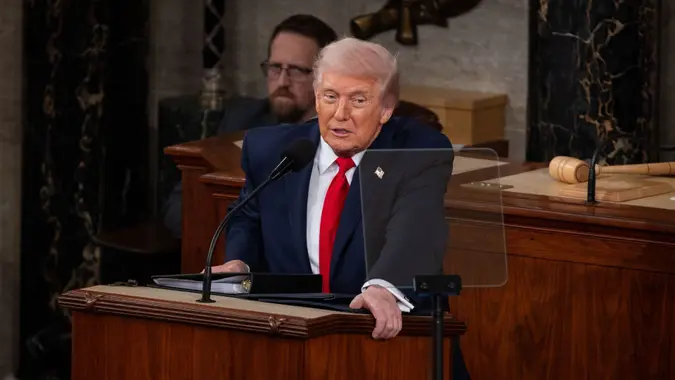
During President Donald Trump’s Feb. 24 State of the Union address, he lamented the gap in the United States’ retirement system.
Specifically, he noted that there are approximately 56 million citizens who have no employer-sponsored savings plans (in which retirement savings are bolstered with matching contributions from an employer).
Calling this gap a “gross disparity,” Trump announced a government solution to the problem.
Trump’s 401(k) Plan
Per CBS News, Trump’s plan is essentially based upon the Thrift Savings option available to federal employees, in which the federal government provides matching contributions up to $1,000 per year.
Trump’s initiative would expand on the Secure Act 2.0 that was signed by President Joe Biden in 2022, with the federal government providing 50% matching contributions up to $1,000 for eligible low-income workers. It will also allow access to low-fee investment funds for stocks and bonds.
Who Benefits?
“The biggest winners are gig workers and employees at small businesses that can’t afford to run a traditional 401(k),” according to Maitland Wealth publisher Steve Maitland — whose research often focuses on the structural elements of the retirement industry.
“The whole appeal of the Thrift Savings Plan model is its simplicity and rock-bottom fees,” Maitland continued. “If lawmakers can replicate that structure for the general public, it removes many of the cost barriers that typically keep middle-income workers out of the retirement market.”
Who Won’t Benefit?
“Mass-brokerages could lose out because a low-cost, government-backed public option cuts of their pipeline of entry-level investors,” Yehuda Tropper, CEO of Beca Life Settlements, told GOBankingRates. “If everyday workers are given a portable plan with rock-bottom fees and potential federal matches, they are a lot less likely to open or maintain higher-fee retail IRAs. Volume-dependent brokerages would then face downward pressure to lower their margins to stay competitive.”
Maitland added that older workers are less likely to benefit, as well.
“Just handing someone an account doesn’t magically create retirement savings,” he noted. “If you’re within five to 10 years of retirement, gaining access to this now probably won’t move the needle much because you simply don’t have the time horizon for compound growth.”
Editor’s note on political coverage: GOBankingRates is nonpartisan and strives to cover all aspects of the economy objectively and present balanced reports on politically focused finance stories. You can find more coverage of this topic on GOBankingRates.com.
More From GOBankingRates