The $2,000 ‘Trump Check’: 3 Ways It Could Affect Your Social Security
 Written by
Gabriel Vito
Written by
Gabriel Vito
 Edited by
Zuri Anderson
Edited by
Zuri Anderson
Commitment to Our Readers
GOBankingRates' editorial team is committed to bringing you unbiased reviews and information. We use data-driven methodologies to evaluate financial products and services - our reviews and ratings are not influenced by advertisers. You can read more about our editorial guidelines and our products and services review methodology.

20 Years
Helping You Live Richer

Reviewed
by Experts

Trusted by
Millions of Readers
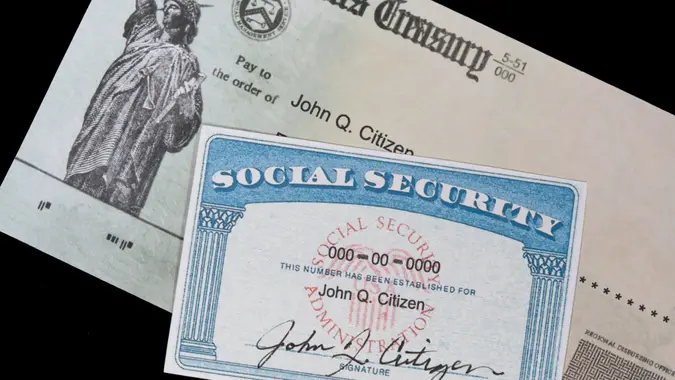
More than 67 million Americans receive Social Security benefits each month, according to the Social Security Administration. That’s why even hypothetical talk of a possible $2,000 federal payment has raised practical questions for retirees and people on fixed incomes.
While no such payment has been approved, past stimulus programs offer a useful reference point. Here are three ways a so-called “Trump check” could affect Social Security benefits, based on expert insight and how previous stimulus payments were treated.
1. A $2,000 Payment Would Likely Not Be Taxed, Based on Past Stimulus Checks
Frank Grimes, president and owner of Associates Home Loan of Florida Inc., said past stimulus payments were structured in a way that avoided tax consequences for Social Security recipients.
“Using past federal stimulus packages as an example, a single $2,000 payment of stimulus money will not be considered taxable income by Social Security recipients,” he explained. “The CARES Act and other subsequent COVID-19 relief packages included provisions to treat stimulus checks as a ‘refundable tax credit’, which, in effect, did not count toward increasing their taxable income for federal tax purposes.”
Grimes said counting stimulus payments as income would have changed that calculation.
“Including stimulus payments, would have required that those receiving stimulus funds be taxed at a higher level than they otherwise would have been had those stimulus payments not been included within their ‘combined income,'” according to Grimes.
If a future $2,000 payment were authorized, its tax treatment would depend on how Congress writes the law, though past stimulus programs provide a reference point.
2. A Hypothetical Payment Would Not Reduce Social Security Retirement Benefits
Social Security retirement benefits are based on a person’s work history and lifetime earnings, not their current income or savings.
Caroline Raker, a registered Social Security analyst, said that while no $2,000 payment has been approved, past stimulus programs offer a clear reference point: “Meaning it would not count as income for Social Security, SSI or Medicaid. The exact treatment would depend on the final law, but historically these payments have been excluded from income.”
In practical terms, that means a one-time payment like this would not reduce a retiree’s monthly Social Security check.
3. SSI and Other Income-Based Benefits Could Depend on the Fine Print
The situation is different for people who receive Supplemental Security Income (SSI) or other income-based benefits, including Medicaid, SNAP or Medicare Savings Programs.
During the COVID-19 stimulus programs, federal agencies issued specific guidance on how those payments would be treated.
“Prior stimulus payments were also excluded from counting as income when received under income-based programs; however, the Social Security Administration and other federal agencies issued guidelines during the COVID pandemic stating that the stimulus payments would not be used to calculate recipients’ SSI benefits, nor would they prevent recipients from receiving Medicaid, SNAP, or Medicare Savings Programs at the time of receipt,” Grimes said.
Those protections were temporary. Grimes explained, “Stimulus monies were also excluded from being considered as ‘countable’ resources, typically for a limited time (up to one year), allowing recipients to spend the monies on essentials without losing their benefits.”
After that exclusion period ended, unspent funds could count toward SSI asset limits under existing rules.
Final Take To GO
No $2,000 stimulus payment has been approved. If one were ever authorized, past stimulus programs provide a framework, not a guarantee.
For most people receiving Social Security retirement benefits, a one-time payment would likely not affect monthly checks. For those receiving SSI or other income-based benefits, the impact would depend on the details written into the law.
As with past stimulus programs, the fine print would matter.
More From GOBankingRates