This Ultimate House Hack Can Break You Free From Expensive Bills And Worrying About Your Job
 Written by
Marc Guberti
Written by
Marc Guberti
 Edited by
Zuri Anderson
Edited by
Zuri Anderson
Commitment to Our Readers
GOBankingRates' editorial team is committed to bringing you unbiased reviews and information. We use data-driven methodologies to evaluate financial products and services - our reviews and ratings are not influenced by advertisers. You can read more about our editorial guidelines and our products and services review methodology.

20 Years
Helping You Live Richer

Reviewed
by Experts

Trusted by
Millions of Readers
House hacking is a popular strategy that often refers to buying a duplex, living in one unit, and renting out the other.
However, there’s a much better house hack that can make you stop worrying about bills and make your life much simpler, if you are willing to embark on an alternative path.
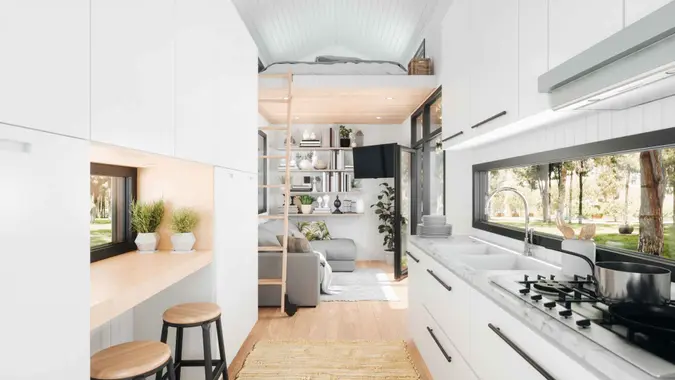
Bree Steen lives in a 144-square-foot tiny home in rural Maine that she built for $10,700. The house includes a kitchen, a living area and a loft with a bed. Tiny homes are an extension of the minimalism trend, but they offer substantial savings.
How Steen Got Into Tiny Home Living
Steen didn’t live off-grid her entire life. A friend invited her to live on their off-grid land. She thought about it for a bit and then decided to take her friend up on the offer. Steen stayed in a camper and saved money to build her own home on the land, and she has been living in it for two years.
Steen was willing to give it a try shortly after securing a 9-to-5 job, but not feeling like it was delivering the big payoff she expected.
“I quickly realized that my life was not feeling like me,” she said.
Most people with 9-to-5 jobs live paycheck to paycheck, and Steen was no exception to the rule before she built her tiny home. The amount of money she spent building the house was less than one year’s rent in her area.
Living Expenses Finally Feel Reasonable
One of the biggest benefits of tiny home living is how affordable your lifestyle becomes. Steen said that she no longer feels trapped at her job and is getting ahead with her finances. She has the flexibility to retire sooner than her peers while working fewer hours. Steen told the Tiny Home Tours YouTube channel that her monthly bills only come to $300 to $400.
“I can save a lot more money each month. I’ve cut down on so much,” she said.
Spending $3,600 to $4,800 per year frees up a lot of capital to invest in stocks and other assets. Low monthly expenses also make it much easier to retire, since your ability to retire depends on if your nest egg can cover your living expenses.
An annual spend that ranges from $3,600 to $4,800 also assists dividend investors who want to live on cash flow. You only need a $120,000 portfolio with a 3% yield to bring in $3,600 per year. If you wanted to make $4,800 in annual dividend income, that same portfolio would have to be $160,000.
Saving that much money becomes more feasible with a tiny home lifestyle. Some people live in tiny homes for the rest of their lives, while others use the opportunity to save a lot of money before buying a suburban house.
How To Make It as a Tiny Home Owner
Steen said it wasn’t easy to adjust to being a tiny home owner, but she is now comfortable with the process. It can take up to a week for some people to become more familiar with tiny home living, especially if they reach out to their neighbors.
“Don’t be afraid to ask for help,” Steen said.
Asking neighbors for help with tiny home living can deepen bonds and make you feel like you are not alone. You will likely need help in the beginning, especially if you have never lived off-grid. Steen chops wood to keep warm in the winter, goes to the bathroom outside and uses a hand-pump well to get water.
It’s a completely different lifestyle from suburban living, but it can make you financially free much sooner.
More From GOBankingRates