Independent Contractor Taxes: What You Need To Pay and When
 Written by
Sophia Acevedo
Written by
Sophia Acevedo
 Edited by
Melanie Grafil, M.A., CFHC™
Edited by
Melanie Grafil, M.A., CFHC™

Commitment to Our Readers
GOBankingRates' editorial team is committed to bringing you unbiased reviews and information. We use data-driven methodologies to evaluate financial products and services - our reviews and ratings are not influenced by advertisers. You can read more about our editorial guidelines and our products and services review methodology.

20 Years
Helping You Live Richer

Reviewed
by Experts

Trusted by
Millions of Readers
An independent contractor, or freelance worker, is responsible for paying certain taxes because they are self-employed and no taxes were withheld from their pay. This includes self-employment taxes — a Social Security and Medicare tax — and income taxes.
Here’s everything you need to know about how to file taxes as an independent contractor.
What Taxes Independent Contractors Pay
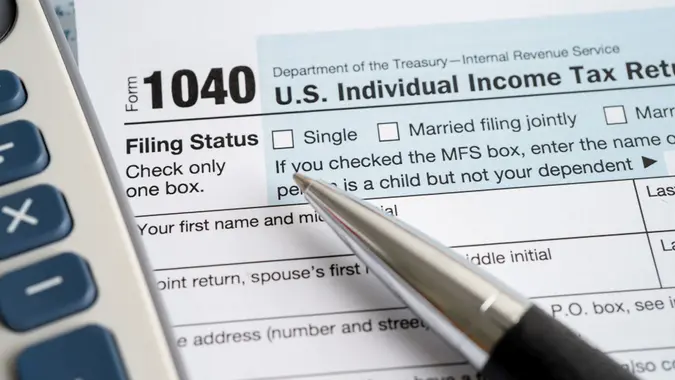
The process of filing taxes as an independent contractor is almost the same as if you were an individual filer. Taxes for an independent contractor are typically due on April 15 of each year. The independent contractor files a Form 1040, just like an employee.
Instead of receiving a W-2 form like you would if you were an employee, you’ll receive a Form 1099-NEC from each company you did contract work with, along with any other forms that show any type of income paid to you directly. You can use these forms when you file your federal tax return. You may also have to file a state return, too, but it depends on where you live and how much you earn.
However, there are differences in how income is reported for contractors. Here’s a breakdown on the difference between self-employment tax and income tax so you know what responsibilities you have to fulfill as a freelancer.
Self-Employment Tax
The current self-employment tax rate is 15.3%, and it’s made up of a 12.4% Social Security tax and 2.9% Medicare tax. You can use Schedule SE to calculate your self-employment tax.
You must pay a self-employment tax because Social Security and Medicare aren’t being withheld from your income, and people in the U.S. who work generally have to pay these taxes.
Income Tax for Independent Contractors
If you earn $400 or more in net earnings, you are required to file an income tax return. Since you are using net earnings instead of gross earnings, you will need to factor in any business expenses, resulting in a lower amount. If you have deductions, those are reported on Schedule C.
Estimated Quarterly Taxes
If you owe more than $1,000 in taxes, the IRS can require you to pay quarterly because taxes have to be paid as you earn income throughout the year. In that case, you would be responsible for calculating how much you owe each quarter. However, a professional tax preparer can also help you. You can also use Form 1040-ES worksheet to assist with calculating the amount.
Estimated tax payments are due four times per year on the 15th of the month following each quarter.
| Income Period | Estimated Tax Due Date |
|---|---|
| Jan. 1 to March 31 | April 15 |
| April 1 to May 31 | June 15 |
| June 1 to Aug. 31 | Sept. 15 |
| Sept. 1 to Dec. 31 | Jan. 15 ( the following year) |
Tax Deductions for Independent Contractors
As independent contractors are technically business owners, they’re allowed to take numerous tax deductions that don’t apply to most wage and salary earners. The most common of these include:
- Home office expenses
- Business supplies and equipment
- Mileage and travel expenses
- Health insurance premiums
Independent Contractor vs. Employee Taxes
An employer is required to withhold income, Social Security and Medicare tax from their employee’s pay. They also pay half of the employee’s Social Security and Medicare taxes. At the end of the year, the employer is required to provide a Form W-2 detailing all wages, and the amount of taxes withheld.
As an independent contractor, the employer does not withhold any taxes. That’s why independent contractor taxes feel higher than W-2 taxes: you’re paying both the employee and employer’s halves of Social Security and Medicare taxes.
Common Mistakes Independent Contractors Make
Tax reporting can be a more difficult process for independent contractors because there are so many opportunities to make errors. Here’s a list of some of the most common mistakes you’ll want to try to avoid:
- Underreporting income
- Failing to meet tax-filing deadlines
- Failing to keep receipts
- Mixing business and personal expenses
What Happens If You Don’t Pay Contractor Taxes?
If you don’t pay contractor taxes, you may receive a notice or letter from the IRS, telling you how much you owe. If you failed to pay tax and you didn’t report it on your return, the IRS charges a penalty on your unpaid taxes for each month it’s still not paid.
The penalty is based on:
- How much you owe
- How late your payment is
- How much you’ve already paid
Final Takeaway
Filing taxes as an independent contractor is a year-round job. Keep diligent records of both income and expenses — and be mindful of tax-filing deadlines — and you can make the process much easier to handle. You’ll also avoid penalties and get all of the tax deductions to which you’re entitled.
Brian Nelson and John Csiszar contributed to the reporting of this article.
FAQs on Independent Contractor Taxes
- Are independent contractors required to pay quarterly taxes?
- Yes, if you owe more than $1,000 in taxes, the IRS can require you to pay quarterly taxes.
- Do independent contractors pay more taxes than employees?
- Independent contractors have to pay both halves of their Social Security and Medicare taxes, while employees only pay one half, and their employer pays the other half.
- When are quarterly taxes due for independent contractors?
- Quarterly taxes are due for independent contractors on January 15, April 15, June 15, and September 15.
- What happens if I don’t pay quarterly estimated taxes?
- The IRS will charge you a penalty plus interest if you don't pay your taxes. The penalty is based on how much you owe, how late your payment is and how much you've already paid.
- Can I deduct my home office if I also work from a co-working space?
- Yes, as a business owner, you are allowed to take various tax deductions, which include home office expenses.
- Can I contribute to a retirement plan as an independent contractor?
- Yes, you can contribute to an SEP IRA, individual 401(k) or a SIMPLE IRA plan.
- What tax forms do independent contractors need?
- Independent contractors need to file using Form 1040, Schedule C, Schedule SE, and Form 1040-ES. You may receive Form 1099-NEC from companies you did contract work with.
Our in-house research team and on-site financial experts work together to create content that’s accurate, impartial, and up to date. We fact-check every single statistic, quote and fact using trusted primary resources to make sure the information we provide is correct. You can learn more about GOBankingRates’ processes and standards in our editorial policy.
- Social Security Administration. 2025. "Must I pay Social Security taxes on my earnings after full retirement age?"
- IRS. 2026. "Forms and associated taxes for independent contractors."
- IRS. 2026. "Estimated Taxes."
- IRS. 2026. "Pay As You Go: So You Won’t Owe — A Guide to Withholding, Estimated Taxes, and Ways to Avoid the Estimated Tax Penalty."
- IRS. 2026. "Failure-to-Pay Penalty."
- IRS. 2026. "Underpayment of Estimated Tax by Individuals Penalty."