5 Cities Where Owning a Bike Can Save You Thousands Per Year
 Written by
Fiona Tapp
Written by
Fiona Tapp
 Edited by
Brendan McGinley
Edited by
Brendan McGinley
Commitment to Our Readers
GOBankingRates' editorial team is committed to bringing you unbiased reviews and information. We use data-driven methodologies to evaluate financial products and services - our reviews and ratings are not influenced by advertisers. You can read more about our editorial guidelines and our products and services review methodology.

20 Years
Helping You Live Richer

Reviewed
by Experts

Trusted by
Millions of Readers
If you’re thinking about ditching or never owning a car, there are some cities around the world where getting around by bike isn’t just greener and healthier, it’s also a major money-saving move.
Between the high fixed and variable costs of car ownership and the much lower costs associated with cycling, commuting by bike can free up a surprising amount of your budget. Here are a few standout cities where biking can save you big.
Why Biking Saves You Money
Before diving into specific places, it’s worth understanding the scale of savings. According to the AAA’s “Your Driving Costs” report, owning and operating a new car in the U.S. costs $11,577 per year, or around $965 per month. That includes expenses like depreciation, fuel, insurance, maintenance and registration.
Now compare that to bicycles. Even when you factor in bike purchase, accessories and occasional tune-ups, the cost remains extremely low compared to car ownership. According to the Iowa Bicycle Coalition, the median repair/maintenance spending for cyclists was $200 per year, with a mean (average) of $307.82 or just $25 per month.
Below are five cities (in Europe and the U.S.) where cycling is not only a practical way to get around, but also a serious money-saving choice, especially compared to the costs of owning and driving a car.
Copenhagen, Denmark
Cycling is incredibly popular and common in Copenhagen, where, according to a 2024 Global Journal of Engineering & Technology Advances paper, 62% of Copenhageners commute by bike.
Why You Save:
According to The Danish Dream‘s guide on cars in Denmark for foreigners, owning a car in Denmark is exceptionally expensive due to high registration taxes that can reach up to 150% of a vehicle’s value, along with annual “green” taxes ranging from 600 to 7,000 DKr. ($90-$1,050) depending on CO2 emissions. Insurance costs typically run between 4,000 and 10,000 DKr. ($600-$1,500) per year, while maintenance and repairs average 3,000 to 6,000 DKr. ($450-$900) annually.
With such a large modal share of cycling, plus very high costs associated with car ownership in Denmark, substituting even a portion of your car trips for a bike can save hundreds to thousands of euros per year in car-related fixed and variable costs.
Potential Savings: Substituting even part of your car trips for a bike can save roughly $1,140-$3,450 per year, based on the combined low and high end of registration, insurance and maintenance costs.
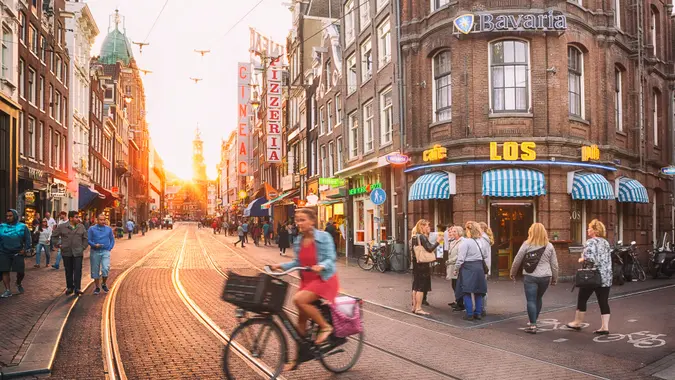
Amsterdam
Cycling is deeply embedded in Amsterdam’s daily life. According to the Netherlands Institute for Transport Policy Analysis (KiM), 28% of all trips in the Netherlands are made by bicycle and in Amsterdam specifically, about 36% of trips are taken by bike. The city has an extensive network of over 515 kilometers of dedicated bicycle paths, according to The Dutch Cycling Embassy, which makes commuting by bike safe, practical and efficient.
Why You Save:
According to Mihogo e-bike’s 2025 analysis of commuting costs in Europe, car-commuting in cities like Amsterdam is extremely expensive, with annual expenses for a 10-kilometer, daily round-trip totaling roughly €7,600 — €13,500 ($8,400-$14,900), including fuel, insurance, maintenance, parking and depreciation. In contrast, owning an e-bike costs only €205-€410 per year ($225-$455), with government incentives further offsetting expenses and perhaps even providing an income of €450-€570 ($500-$630).
Using a manual bike instead of an e-bike reduces costs even further, making cycling an exceptionally economical alternative to car ownership.
Potential Savings: Cycling instead of driving can save $8,400-$15,300 per year.
Berlin
Cycling is becoming increasingly popular in Berlin, which, according to a 2024 Euronews assessment, has 1,000 kilometers of cycling infrastructure and multiple bike-rental schemes, making biking both practical and convenient.
Why You Save:
With extensive bike lanes, rental options and city support for cycling, Berliners can replace many car trips with bicycles. Considering the high costs of car ownership in Germany, registration fees, insurance, fuel, maintenance and parking, switching to a bike for commuting or errands can save hundreds to thousands of euros per year in fixed and variable vehicle expenses. In a cost comparison published by European electric bike manufacturer Pixar Bikes, a Berlin commuter who gives up a car can potentially save €1,960/year ($2,078 per year) in commute-related costs alone (fuel, insurance, maintenance).
Potential Savings: Commuters in Berlin can save around $2,078 per year by switching to a bike.
London
Cycling has surged in London in recent years. According to Transport for London’s (TfL) Travel in London report, there were an estimated 1.33 million daily cycle journeys in 2024, up 5% from 2023 and a remarkable 26% increase since 2019. Concurrently, TfL reports that London’s strategic cycle network has expanded dramatically. Since 2016, the city’s bike routes has grown from just 90 kilometers to over 400 kilometers by September 2024, connecting more than 600,000 Londoners, with 20 new routes, formally dubbed Cycleways, added in 2023 and 2024 alone. This infrastructure expansion means that 27.4% of Londoners now live within 400 meters of a cycle route.
Why You Save:
According to TfL, driving within central London requires paying a congestion charge of £15 ($19) per day during charging hours (weekdays 7 a.m. to 6 p.m.; weekends noon to 6 p.m.).
By biking instead, you avoid this hefty daily fee entirely, as well as parking charges making cycling a much cheaper option for regular commuters.
Potential Savings: Depending on commuting frequency, regular cyclists can save hundreds to thousands of dollars per year.
Portland, Ore.
Cycling in Portland has become increasingly prevalent and shows real signs of growth. According to the Portland Bureau of Transportation, bike ridership increased by 5% in 2023 compared to 2022, with PBOT counting approximately 22,400 daily riders across the city in its 2023 survey. Notably, 17% of all bike trips recorded in that count were made on e-bikes, a clear signal that electric-assist cycling is gaining traction.
PBOT reports that Portland’s bikeway network spans over 400 miles, including around 100 miles of low-stress neighborhood greenways.
Potential Savings: Regular cyclists in Portland can save thousands of dollars per year.
Why You Save:
Given this growing adoption of e-bikes and the strength of Portland’s cycling network, switching regular short or medium car trips to bike trips can significantly lower your transportation costs. Given how expensive car ownership is in the U.S. (insurance, fuel, maintenance, parking) and reasonable assumptions on bike costs, regular cyclists in cities like Portland can potentially save thousands of dollars per year by choosing two wheels over four.
Why Swapping Your Car for a Bike Makes Dollars and Sense
If you live in, or are considering moving to, one of these five cities, swapping a car for a bike isn’t just a green choice, it’s a financially smart one. Whether you’re dealing with Danish fuel taxes, Dutch parking fees, London congestion charges or U.S. insurance costs, the math often falls in favor of cycling. Over time, these savings can add up to thousands of dollars per year.
Choosing a bike over a car means more than just saving money; however, it’s also an investment in a more livable, sustainable future for both your wallet and your community.
More From GOBankingRates