What You Need To Save Monthly To Retire Comfortably in Every State — Experts Explain
 Written by
Rudri Bhatt Patel, CFHC™
Written by
Rudri Bhatt Patel, CFHC™
 Edited by
Elizabeth Constantineau, CFHC™
Edited by
Elizabeth Constantineau, CFHC™

Commitment to Our Readers
GOBankingRates' editorial team is committed to bringing you unbiased reviews and information. We use data-driven methodologies to evaluate financial products and services - our reviews and ratings are not influenced by advertisers. You can read more about our editorial guidelines and our products and services review methodology.

20 Years
Helping You Live Richer

Reviewed
by Experts

Trusted by
Millions of Readers
In 2026, defining what a comfortable retirement looks like depends largely on geography. A recent GOBankingRates analysis found that the cost of living for retirees in states like Hawaii or New York is now nearly double that of the Midwest. What may be a solid nest egg in one state can feel like a thin safety net in another. The question for 2026 isn’t just how much you need to save, but where you plan to spend it.
First Take
- Choosing to retire in Hawaii over West Virginia costs an extra $2.4 million in savings over a 20-year retirement.
- The best value for your savings is in Alabama, Arkansas and West Virginia. These states consistently offer the lowest barriers to a comfortable retirement.
- Retiring comfortably in Hawaii, California, Massachusetts, Washington or New Jersey requires more than $115,000 a year.
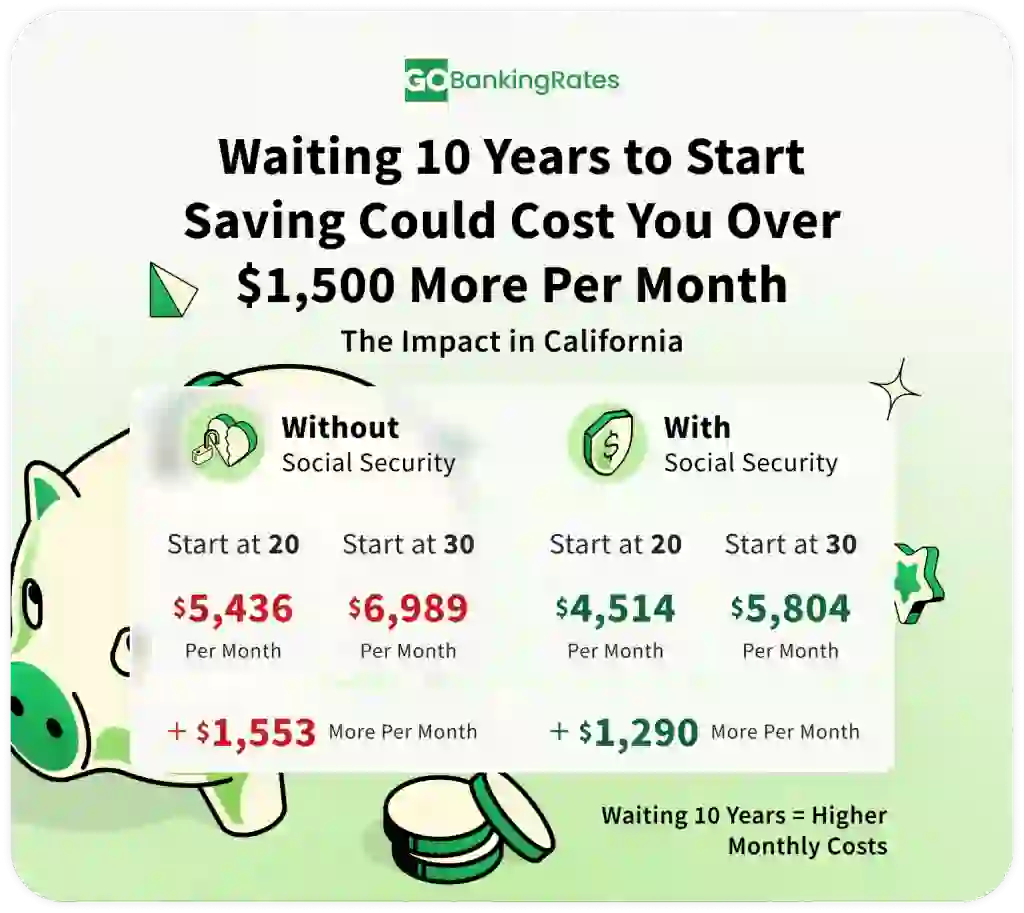
- Starting at age 20 reduces your monthly savings burden by nearly 30% compared to starting at 30.
- Social Security helps cover costs, but it’s best viewed as a supplement — not a full retirement plan.
As of 2026, the average retired worker receives $24,894 annually from Social Security, which is an estimated $2,075 per month. Over time, those payments add up to a significant portion of retirement costs.
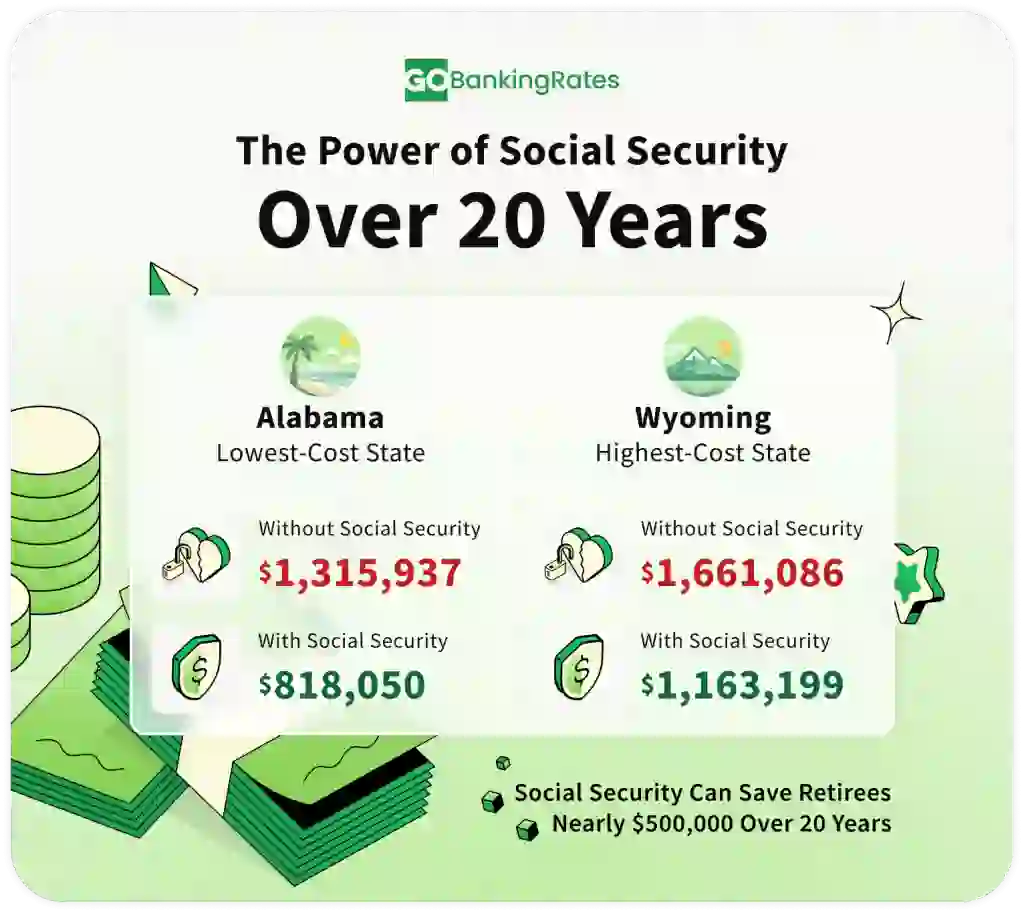
- In GOBankingRates’ survey of state-by-state costs, the six most expensive states to retire are Hawaii, California, Massachusetts, Washington, New Jersey and Colorado.
- In these states, high housing costs and utilities drive the annual requirement well into six figures.
- Even after accounting for Social Security income, retirees would still need a nest egg of $1.8 million to $3.1 million to sustain a 20-year retirement.
- After accounting for Social Security, retirees will need to come up with an additional $90,000 to $156,000.
Traditional Retirement Havens Still Require a High Nest Egg
Retiring in Florida or Arizona may not come with the highest price tag, but it still requires significant savings.
Florida
- Requires an additional $63,445 per year after Social Security
- No state income tax
- Higher home insurance costs due to hurricane risk
- Requires about $1.3 million over 20 years to retire comfortably after Social Security
Arizona
- Requires roughly $68,642 per year after Social Security
- Has a state income tax
- Lower property insurance costs than Florida
- Requires around $1.4 million over 20 years to retire comfortably after Social Security
Where Your Retirement Dollars Go Further
The states that offer the most mileage for your retirement dollars are West Virginia, Mississippi, Louisiana, Arkansas, Oklahoma and Kentucky.
- In these states, you need about $33,000 to $40,000 annually after Social Security benefits.
- In West Virginia, Social Security covers about 43% of total costs.
- In these six states, a 20-year retirement requires a nest egg of roughly $660,00 to $804,000.
What’s Driving Retirement Costs Across States in 2026?
Retirement costs vary widely depending on essential living expenses like housing, groceries and healthcare.
Housing Costs Are the Primary Driver
- The national average for a monthly mortgage is $2,100.
- In Hawaii, this cost spikes to $5,201 per month, while even in mid-range states like California, it stays above $4,250.
- In high retirement cost states such as Massachusetts and Washington, about 50% of the monthly budget is taken up by housing costs.

Healthcare Cost Is a Secondary Driver
- Average healthcare costs are about $660 per month nationwide.
- In Alaska, healthcare costs average over $900 per month.
- Massachusetts residents pay about $896 per month, while Hawaii residents pay slightly less at $812.
Everyday Costs Are an Added Burden in Retirement
Utility and grocery costs can also factor into your retirement burden. On average, groceries cost $445 per month, while monthly utilities cost $384.
Here’s a side-by-side comparison between the most and least expensive states:
| Category | The High End: Hawaii | The Low End: West Virginia |
|---|---|---|
| Groceries | $591 | $424 |
| Healthcare | $812 | $608 |
| Utilities | $776 | $346 |
| Total monthly necessities | $7,563 | $2,422 |
| Social Security coverage | 27% | 85% |
Even with Social Security, retirees need about $13,050 per month to live comfortably in Hawaii.
How Your Starting Age Impacts What You Need To Save
Starting earlier dramatically lowers the monthly amount you need to save for retirement.
What the Numbers Mean for Retirees in 2026
As we look at the financial landscape of 2026, the biggest takeaway is this: Your retirement savings aren’t just a number in a bank account. You can’t just outsave a high-cost ZIP code.
Ultimately, where you choose to live and how you navigate housing and healthcare will do more to define your freedom than your actual return on investment.
Geography Shapes Retirement Comfort
Those who want to evaluate their nest egg and how far it will go need to understand that geography will determine their comfort level in retirement.
Retirees should access relocation while they still have the health and resources to relocate, with the understanding that their retirement dollars can go farther in one state than another.
Where $1 Million Goes Further
- West Virginia: $1 million over 20 years can support a comfortable retirement.
- Hawaii: That same $1 million stretches far less due to significantly higher housing and living costs.
Healthcare Adds Another Layer
Healthcare costs complicate the retirement equation. Future health is unpredictable, but geography still plays a role. States with lower populations pay more because of higher administrative costs and a lack of competition. For example:
- Oregon: $788 per month
- Nevada: $549 per month
In states where healthcare is a big part of the cost, expect almost half of your Social Security benefit to pay for this expense.
Planning Beyond the Projections
Retirees will likely need to take a more holistic approach to their portfolios rather than relying on projections alone. Location — and the housing and healthcare costs tied to that location — can significantly impact how long your nest egg lasts.
Financial Experts Weigh In
Starting Early Still Works
“Targets are ambitious but achievable for people who start early.”
– Andrew Lokenauth, money expert and owner of Fluent in Finance
Andrew Lokenauth, owner of Fluent in Finance, says the GOBankingRates study’s retirement targets feel “close to reality for most Americans.” But he warns retirees not to get too comfortable with averages.
“Averages hide pain. A retiree in Mississippi living on $59,000 looks very different from the one in California or Hawaii,” Lokenauth said.
Lokenauth believes the issue is much bigger than the number being right or wrong. “Most people have no idea what their own retirement will actually cost until it’s too late.”
Retirement planner D’Andre Clayton agrees the numbers in the study are accurate, but also suggests that certain assumptions are made.
“Studies often assume a static tax bracket, flat healthcare inflation, no IRMAA surcharges, no long-term care events or no return disruption,” Clayton said.
Clayton asserts that the “targets in the study look achievable, but behaviorally they’re unlikely for the average household.” The assumptions, in his opinion, are based on the following:
- Consistent employment
- No family support obligations
- Perfect discipline that is void of panic selling in a market that is very unpredictable
Retirement Rarely Moves in a Straight Line
“Nothing takes place in a linear fashion.”
-D’Andre Clayton, retirement planner
Retirement Math: Expert Tips on Timing, Social Security and Location
Experts Lokenauth, Clayton and certified financial planner (CFP) Alonso Rodriguez Segarra agree that a successful retirement depends on the following:
- Saving early so you can leverage compound growth
- Viewing Social Security as a supplement
- Establishing a budget that focuses on specific costs rather than portfolio growth
- Adjusting for a 30-year lifespan
Starting Late To Save for Retirement Will Cost You
Starting late, according to Lokenauth, is the single biggest retirement mistake. It isn’t necessarily picking the wrong stock or missing a market rally.
“Every decade you delay roughly doubles the monthly savings you’d need to hit the same goal. I’ve seen this play out firsthand with clients who delayed saving through their 30s, then faced the brutal math of trying to retire comfortably in their 60s,” Lokenauth said.
Clayton advised not to make the mistake of thinking that retirement and portfolio management are the same thing.
Budgeting With Intention
“The average person makes the mistake of not assigning purpose to the dollar.”
-D’Andre Clayton, retirement planner
Social Security Is Not a Safety Net
“Build your own savings as if Social Security doesn’t exist,” Lokenauth said.
From his perspective, Social Security was designed as a supplement, not a retirement plan.
Here’s what he’s seen work in practice: “The people who treat Social Security as a bonus rather than a baseline retire with far more security and flexibility.”
Social Security Looks Different Depending on Income
“My wealthier clients are more focused on when they should take Social Security, instead of looking at it as a replacement for income.”
-Alonso Rodriguez Segarra, CFP
Segarra also notes that lower-income retirees often worry whether Social Security benefits will be enough to cover major expenses.
Specificity Is Key in High-Cost States
Understanding how the retirement costs play out based on where you live is key.
“Living in California or Massachusetts isn’t just expensive,” Lokenauth explains. “It’s roughly 40% to 50% more expensive than the national average, based on the cost-of-living data in the study.”
In these states, your retirement target may be closer to $1.7 million or more.
Retirement Planning Tip
“Run the retirement math using your state’s actual cost of living index, not national averages.”
– Andrew Lokenauth, money expert and owner of Fluent in Finance
Clayton agrees that relocation in retirement may be a good strategy because you’re making the choice to protect a great deal of your income.
“Moving to a lower-cost state in retirement can effectively give you a 20% to 30% raise on your savings overnight,” Lokenauth said.
Segarra has seen this play out in practice, particularly among retirees leaving high-cost states.
Hidden Costs Can Reshape Retirement Plans
“Some of my clients in Florida find that the home association fees and special assessment fees price them out of living here.”
– Alonso Rodriguez Segarra, CFP
He has also observed clients relocating to states like Texas, Georgia and the Carolinas — and in some cases moving abroad to places like Portugal and Spain — when ongoing housing or healthcare expenses become unsustainable.
Consider Life Expectancy in a 20-Year Retirement Horizon
Lokenauth does believe 20 years is a reasonable retirement period, but he also encourages retirees to look at their basic necessities as a floor, not the ceiling. He said the study makes the assumption that people are retiring at 65 and living until 85.
“Life expectancy keeps climbing, and I’d personally plan for 25 to 30 years if you can. Running out of money at 87 because you only planned to 87 is one of the most financially devastating situations a person can face,” Lokenauth said.
He recommends planning for a longer scenario. Any leftover income can become your legacy.
Segarra sees many of his clients working longer and retiring beyond 67. This approach is to anticipate a longer retirement into the late eighties and nineties.
Final Take: What You Can Do Now To Stay on Track
Retirement isn’t a last-minute goal — it takes planning, starting from your 20s. Here’s what you can do, starting today, to make the most of your pre-retirement years.
Start Saving in Your 20s
Starting in your 20s gives you the lowest required saving rate and the greatest benefit from compound growth.
- Open a high-yield savings account.
- Participate in a 401(k) and take advantage of employer matches.
- Invest in diversified stocks.
- Focus on a small, but consistent savings approach.
Remember, starting to save at age 20 reduces your lifelong monthly savings burden by about 28% compared to waiting until 30.
Focus on Catching Up in Your 30s
If you weren’t aggressive with your savings in your 20s, you may face trying to catch up in your 30s.
- Focus on what you can control.
- Try to avoid lifestyle creep, especially in high-cost areas.
- Be prepared to save more if you live in an expensive area.
- Run retirement math, so you know where you stand financially.
If You’re 50 or Older — Pivot If Necessary
At this stage, strategy matters more than speed.
- Find out the true cost of living in your ZIP code.
- Factor in housing costs and healthcare expenses.
- Consider relocating to a lower-cost state if necessary.
- If you do remain in a high-cost state, prioritize paying off your mortgage before retirement.
Methodology: For this study, GOBankingRates analyzed each U.S. state to find out how much you need to save monthly to have a comfortable retirement. Several factors were found for each state, including total population, population ages 65 and over, total households and household median income, all sourced from the U.S. Census American Community Survey. The cost-of-living indexes were sourced from the Missouri Economic and Research Information Center for 2025. Using the national average expenditure costs for retired households, as sourced from the Bureau of Labor Statistics Consumer Expenditure Survey for retired consumer units. The average single family home value was sourced from the Zillow Home Value Index. Using the national average 30-year fixed mortgage rate of 6.11, as sourced from the Federal Reserve Economic Data on Feb. 11th, 2026, the average mortgage can be calculated for each state. Using the average mortgage and expenditure costs, the total cost of living for necessities can be calculated. Using the 50/30/20 finance rule that states that needs should not exceed 50% of household income, the total cost of living for necessities was doubled to find the comfortable cost of living. Using the average monthly Social Security income for one retired worker, the total cost of living comfortably after Social Security income can be calculated for each state. Assuming a person retires at 65 and lives to 85, 20 years of retirement can be calculated with and without Social Security income. Assuming a person starts saving at 20 or 30 years old, the monthly amount needed to retire with and without Social Security income can be calculated for each age. All data is up to date as of Feb. 11, 2026.