Trump’s Tariffs: How the Upcoming Supreme Court Decision Could Impact the Stock Market
 Written by
Kerra Bolton
Written by
Kerra Bolton
 Edited by
Jenna Klaverweiden
Edited by
Jenna Klaverweiden
Commitment to Our Readers
GOBankingRates' editorial team is committed to bringing you unbiased reviews and information. We use data-driven methodologies to evaluate financial products and services - our reviews and ratings are not influenced by advertisers. You can read more about our editorial guidelines and our products and services review methodology.

20 Years
Helping You Live Richer

Reviewed
by Experts

Trusted by
Millions of Readers
For most investors, Supreme Court decisions feel distant from everyday financial life.
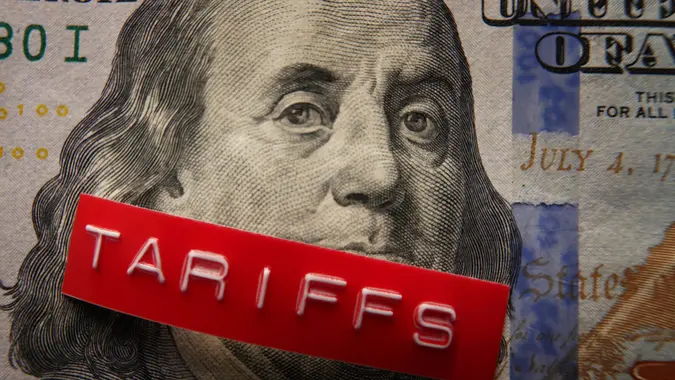
However, when a ruling has the potential to shape trade policy, markets often pay attention, and so do retirement portfolios that track them. The Supreme Court is expected to weigh in on a case involving President Donald Trump and his use of tariffs, a decision that could influence how investors think about corporate costs, profits and uncertainty across the stock market.
How could the eventual decision on Trump’s tariffs affect the stock market?
Also see five ways tariffs could hit your wallet in 2026 — and how to prepare.
What the Supreme Court Is Deciding
The Supreme Court is reviewing a case that challenges how much authority the president has to impose tariffs under existing law. The decision could clarify whether Trump can use those powers broadly or whether limits apply.
The ruling may affect how easily tariffs can be used in the future. For investors, that matters because trade policy uncertainty can influence market expectations.
How Tariffs Can Affect Company Profits
Tariffs raise the cost of imported goods. Many companies have disclosed that higher tariffs increase input costs and pressure profit margins.
Those disclosures matter to investors because stock prices reflect expectations about future earnings. When costs rise or profit outlooks weaken, market valuations can adjust over time.
How That Can Show Up in Retirement Portfolios
Most retirement accounts, including 401(k)s and IRAs, are invested in diversified funds that track broad market performance.
BlackRock asset managers found that tariffs can affect expected returns by raising company costs and contributing to inflationary pressures. These forces can influence asset prices across portfolios, even for investors who do not hold individual stocks.
What Investors May Watch After the Ruling
Market analysis from J.P. Morgan suggested the Supreme Court’s decision would probably have very little impact on overall tariff levels. Even if the Supreme Court invalidates tariffs imposed under emergency authority, the administration is expected to move quickly to replace them using other legal tools, per J.P. Morgan.
Where the ruling could matter more for markets is uncertainty. J.P. Morgan analysis found that another round of tariff announcements could follow, which can prompt investors to reassess company costs, earnings expectations and fiscal assumptions.
One open question is refunds. If the tariffs are struck down, more than $135 billion in collected revenue could become eligible for refunds, per J.P. Morgan. However, it’s unclear how companies may ultimately pursue or receive them. While refunds could create short-term pressure on government finances, the broader fiscal outlook may remain largely unchanged if replacement tariffs are implemented.
For stocks, J.P. Morgan noted that a relief rally is possible but uncertain, particularly if additional tariffs follow. Tariff-sensitive companies have already lagged the broader market, and short-term volatility could increase even as longer-term market trends continue to drive performance for diversified investors.
What the Ruling Does and Does Not Mean for Investors
The Supreme Court’s decision likely will not change investment accounts overnight. A ruling does not automatically raise or lower stock prices, impose new tariffs, or require retirement investors to take immediate action.
For long-term investors, including those saving for retirement, short-term market volatility does not usually require changes to an existing investment plan. Investor guidance from FINRA, a financial industry regulator, encourages investors to stay focused on long-term goals and avoid impulsive decisions when markets become volatile or economic conditions change.
This means that headlines around court rulings may create short-term market noise, but retirement portfolios are generally built with longer time horizons in mind. Maintaining focus on long-term goals rather than reacting to individual events is a core principle of retirement investing.
Editor’s note on political coverage: GOBankingRates is nonpartisan and strives to cover all aspects of the economy objectively and present balanced reports on politically focused finance stories. You can find more coverage of this topic on GOBankingRates.com.
More From GOBankingRates