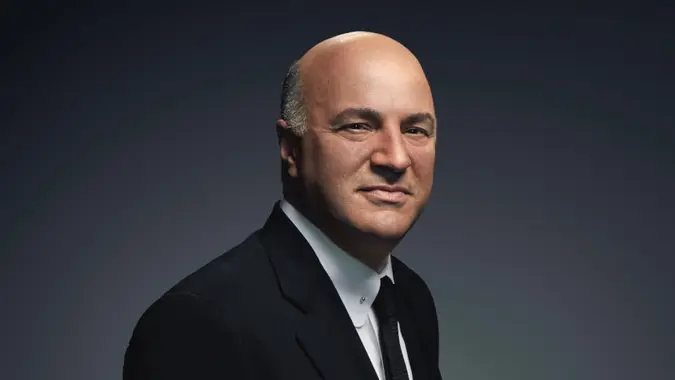
The 5 Best Money Lessons Humphrey Yang Wishes He’d Known in His 30s
 Written by
Ellie Diamond
Written by
Ellie Diamond
 Edited by
Brendan McGinley
Edited by
Brendan McGinley

Commitment to Our Readers
GOBankingRates' editorial team is committed to bringing you unbiased reviews and information. We use data-driven methodologies to evaluate financial products and services - our reviews and ratings are not influenced by advertisers. You can read more about our editorial guidelines and our products and services review methodology.

20 Years
Helping You Live Richer

Reviewed
by Experts

Trusted by
Millions of Readers
When you start building wealth at a young age, that wealth has more time to grow. Cumulative interest and investment gains can add up over time, leaving you much wealthier if you make the right decisions early.
Money expert Humphrey Yang understands the value of early money lessons. In a recent video on his YouTube channel, he shares money lessons he wishes he’d learned earlier in life — though, still in his 30s, he still has time to apply them himself.
1. Income Matters More Than Expenses
Money experts frequently focus on managing your expenses, often to increase your savings rate. However, as Yang said in his video, people typically get more value from learning how to increase their income.
For example, the median annual savings from switching car insurance is $461, according to a Consumer Reports survey. That works out to between $38 and $39 per month.
Based on data from the U.S. Bureau of Labor Statistics, the median annual salary for a 30-year-old person in the U.S. is $59,228. If you earn a 5% salary increase or switch jobs to something that pays 5% more, that’s almost $247 more per month.
By that logic, if you can only focus your energy on one place, it makes more sense to concentrate on earning more. Yang recommends taking courses or earning certifications to increase your marketable skills.
2. Don’t Borrow To Buy Depreciating Assets
This advice applies to any purchase that decreases in value, but Yang admits to speaking specifically to new car buyers.
In June 2025, Experian calculated the average interest rate on a new car to be 5.18%. If you bought a $50,000 car with that interest rate and a five-year loan term, you’d pay $2,378 in interest over that first year. Meanwhile, your car has depreciated by approximately 16%, or $8,000, according to Kelley Blue Book. In only 12 months, your net worth has dropped by over $10,000.
Now, suppose you don’t take out the loan and instead put that money into an investment account. Using the 10-year Dow Jones average of 10% annually, you could end up with $174,494 after 30 years.
As a young person with plenty of time to invest, Yang says, it’s financially smarter to buy a used car with no to minimal debt. Older cars depreciate more slowly than new cars, and no loan means no interest rate. If you do have to borrow, he says, it’s better to borrow as little as possible to buy a reliable car.
3. Use Your Prior-Year IRA Contribution Window
Maximizing your contributions to an individual retirement account is a smart way to grow your net worth, especially when you’re younger. IRAs and Roth IRAs have annual contribution limits, which for 2025 are $7,000 for those under 50. For 2026, that limit is $7,500.
The Internal Revenue Service gives you until the next filing deadline to contribute for the current year. That’s especially good news when the end of the year is approaching and you haven’t reached your maximum.
4. Consider the Value of Peace of Mind
Your 30s are full of financial decisions. Do you invest your holiday bonus or use it to pay off your student loans? The example Yang uses is a friend who was deciding to buy a car or invest the money instead.
Yang encourages viewers to consider emotional cost when crunching the numbers. If debt causes you to dwell on the opportunities you’re losing out on, there’s peace of mind in avoiding it. Conversely, if you buy a cheaper car with cash and worry constantly about repairs, a modest loan may ease your concerns.
Figure out your peace-of-mind priorities in your 30s, and you can feel better about money decisions throughout your life.
5. Your Genius Friend Isn’t a Genius
As an investment professional, Yang knows that the market can be volatile. Yet even he succumbs to temptation when someone smart makes a stock recommendation. This happened in 2023, when a friend recommended a few stocks that all grew in value.
“When he came to me this year with another stock he liked, I blindly invested,” he says. “And guess what? I lost money.”
Yang tells viewers to question and research every opportunity, no matter what’s happened in the past. It’s about taking financial accountability — a valuable habit at any age.
More From GOBankingRates