Jeff Bezos’ Most Outdated Piece of Advice (But Can It Still Work?)
 Written by
Nicholas Morine
Written by
Nicholas Morine
 Edited by
Amen Oyiboke
Edited by
Amen Oyiboke

Commitment to Our Readers
GOBankingRates' editorial team is committed to bringing you unbiased reviews and information. We use data-driven methodologies to evaluate financial products and services - our reviews and ratings are not influenced by advertisers. You can read more about our editorial guidelines and our products and services review methodology.

20 Years
Helping You Live Richer

Reviewed
by Experts

Trusted by
Millions of Readers
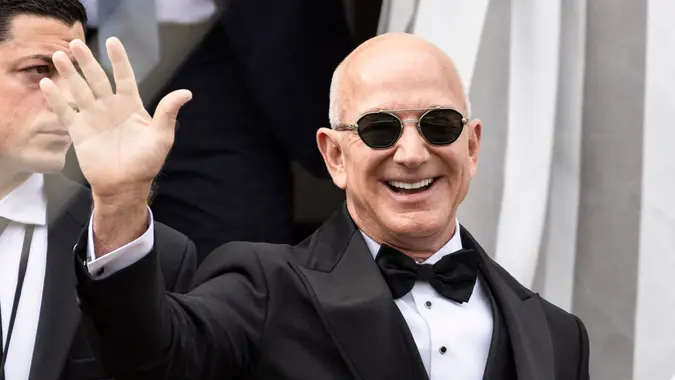
Formerly the wealthiest man on the planet, and still in the running, Amazon founder Jeff Bezos frequently offers up quips and witticisms tied to the world of business, including entrepreneurial endeavors.
When it comes to his advice delivered on the topic of entrepreneurship, Bezos has defended his vision of the “missionary” versus “mercenary” business ethos, with these competing philosophies clashing — and the former emerging victorious.
“I tell people that when we acquire companies, I’m always trying to figure out: Is this person who leads this company a missionary or a mercenary?” Bezos said in 2015. “The missionary is building the product and building the service because they love the customer, because they love the product, because they love the service. The mercenary is building the product or service so that they can flip the company and make money.”
“One of the great paradoxes is that the missionaries end up making more money than the mercenaries anyway. And so pick something that you are passionate about, that’s my number one piece of advice,” he added.
Does this advice hold up a decade later?
Bezos’s Favoring of the Missionary Versus the Mercenary May Wither in the AI Age
Given the massive AI boom dominating headlines worldwide, Bezos’ advice on the issue has been contested by industry analysts and insiders observing the rapidly growing — yet still nascent — sector.
According to reporting from The Times, several experts pointed to the long-standing missionary-versus-mercenary debate, arguing that mercenaries are currently outperforming missionaries in this segment.
“[Silicon Valley] is the new Wall Street. It’s a way to make a lot of money. And I think over time, what that does to missionaries and mercenaries is you organically get way more mercenaries,” said Deedy Das, a partner at Menlo Ventures. “Even just being a founder today, for most young people, is more a status symbol than it is a mission. … It’s a résumé item. It’s the new Harvard Business School.”
A second Silicon Valley venture capital executive, who requested anonymity, described the AI boom as fueling a “mercenary hysteria,” pointing to recent compensation packages from Meta reportedly valued at $200 million.
“It’s one thing to be a missionary. It’s another thing to be a missionary and feel like you could be making $100 million if you weren’t,” the source said.
Read More: If Bezos’ Wealth Was Evenly Distributed Across the US, How Much Would We Get?
Find Out: 6 Safe Accounts Proven To Grow Your Money Up To 13x Faster
Can Missionary Business Philosophy, as Bezos Suggests, Still Perform Adequately?
The answer to the above question is certainly within the realm of subjectivity, but the answer is yes if you apply the lens of business logic to the equation.
Retaining the primary drive of the mission — that is, motivation, endurance, and attention to quality and details — can instantiate a competitive moat around your core business. These factors can also serve as differentiators, in the long run, as compared to more mercenary attitudes zeroed in on scoring a quick buck, which many customers and clients might resent.
There’s nothing hard and fast about these apparently opposing viewpoints being mutually exclusive, either. Borrowing a bit of a mercenary position, say, about one’s own salary negotiations could be conducive to personal financial progress — particularly when backstopped by an established work ethic rooted in a dedicated and effective missionary business ethos.
While Bezos’ words might have been more reflective of Amazon’s earlier growth era, there’s little doubt that his company has remained competitive, highlighting the worth of his ideas as an iconic leader of a large enterprise.
More From GOBankingRates