Gen Z Thinks This Boomer Way of Spending Wisely Is ‘Cringe’
 Written by
Dawn Allcot
Written by
Dawn Allcot
 Edited by
Brendan McGinley
Edited by
Brendan McGinley

Commitment to Our Readers
GOBankingRates' editorial team is committed to bringing you unbiased reviews and information. We use data-driven methodologies to evaluate financial products and services - our reviews and ratings are not influenced by advertisers. You can read more about our editorial guidelines and our products and services review methodology.

20 Years
Helping You Live Richer

Reviewed
by Experts

Trusted by
Millions of Readers
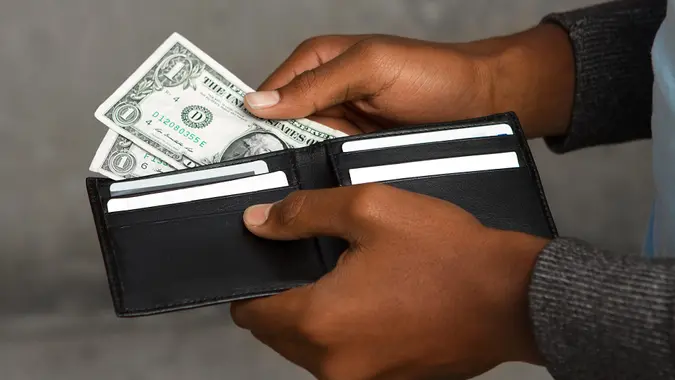
Gen Z, the cohort born between 1997 and 2012, disagree with Gen X and boomers on many topics: slang words, TikTok trends and phone calls vs. texting, to name a few. Gen Z may not be afraid to raid mom’s closet for baggy jeans, flannels or well-worn Doc Martens. But they might cringe when she pulls cash out of her wallet at the shopping mall.
A new Harris Poll conducted on behalf of Cash App revealed that 29% of Gen Z believe people who pay with cash are “out of touch” or “cringe.”
It’s not just that cash is just old-fashioned and crawling with germs, though those are true, too. Digital payments actually have a number of advantages.
Benefits of Digital Payments
Digital wallets, debit cards and payment apps help younger generations keep better track of their money, according to experts.
“I think we’re inevitably moving toward digital dominance In how we pay for things and receive money,” said Sofiya Deva of Verde Money, parent company of the AI money coaching app, Vera. “It’s extremely trackable, even if you’re not the most diligent person in terms of saving receipts or keeping your own spreadsheets.”
Digital and card payments are more secure than cash. They also make it easy to request a refund after a purchase even if you didn’t keep the receipt.
Rewards credit and debit cards, along with retailer-specific apps, may offer cash back on purchases. There’s another level of financial optimization possible with digital.
Yet, for decades, people thought using cash could lead to spending, and saving, more wisely than letting digital finances stay ethereal. Which generation is right?
Enter the Time-Tested Envelope Budgeting Method
Many people use the “envelope method” of budgeting, popularized by personal finance expert Dave Ramsey. This cash-based strategy requires placing money in different envelopes for different purposes.
For instance, you might have envelopes for groceries, gas and eating out. When the money in that envelope is gone, it’s gone. You can’t dip into another envelope to make up for shortcomings or use a credit or debit card.
By making the money you spend very tangible, you might think twice before dipping into the envelope. You can also keep track of how much you spend in each category, without logging into a banking app.
Some online banks, notably Ally Bank and SoFi, offer savings buckets within their apps that operate on similar premises. But you’re losing an important part of the equation: handling actual cash.
“There’s a psychological effect that comes into play when people have physical cash in their pocket they’re relying on. There’s a finite amount of money you can spend because you’re only making a finite amount of money,” Thomas Rudzewick, President and CEO of Maspeth Federal Savings, previously told GOBankingRates.
But Does Envelope Budgeting Work Equally Well for Every Generation?
Do people really spend less when they use cash versus a credit card? Older studies from sources as varied as The Federal Reserve Bank of Boston and the Journal of Applied Psychology have revealed that might be the case.
For instance, in 2016 the Boston Fed reported that people were willing to pay 409% more with a credit card than with cash. The Journal of Applied Psychology revealed that people tipped more, in cash or credit, when a credit card logo appeared near their bill.
Gen Z and millennials don’t believe the research holds true today — at least, not for the younger generations.
More than half (54%) of adult Gen Z and millennial Harris Poll respondents said they’re more likely to spend without thinking when they use cash. Only 33% of Gen X and 21% of baby boomers said the same.
“When I have cash in hand, it almost feels like it’s a surplus because I don’t think of it as part of my formal accounts,” Deva said.
Money in a bank account has a limiting purpose, especially if you have bills set up on autopay.
“I tend to deploy cash for the informal economy,” Deva said. “Tips, birthday gifts, shopping, a farmer’s market — little extras. It’s harder to fit it into a larger financial discipline.”
So, which generation is right?
“I don’t think the debate is really between cash and digital,” Deva said. “It’s about having a system and financial habits that really work for you and aren’t just defaults based on avoidance or anxiety.”
More From GOBankingRates