$100K 401(k) Plans Are Growing, but Many Are Still Massively Unprepared for Retirement
 Written by
John Schmoll
Written by
John Schmoll
 Edited by
Zuri Anderson
Edited by
Zuri Anderson

Commitment to Our Readers
GOBankingRates' editorial team is committed to bringing you unbiased reviews and information. We use data-driven methodologies to evaluate financial products and services - our reviews and ratings are not influenced by advertisers. You can read more about our editorial guidelines and our products and services review methodology.

20 Years
Helping You Live Richer

Reviewed
by Experts

Trusted by
Millions of Readers
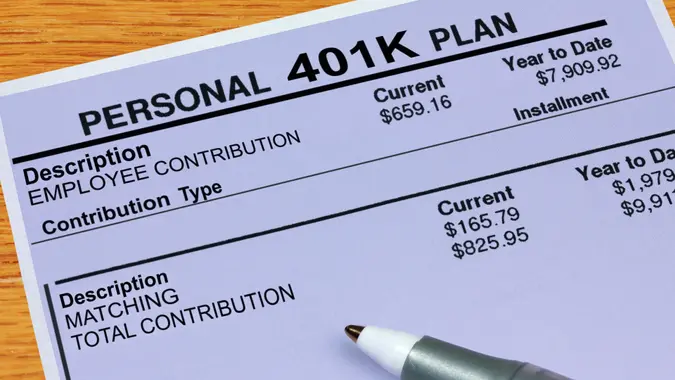
The 401(k) plan is a popular retirement savings tool. Americans can deposit funds and often receive a matching contribution from their employer to help grow their retirement savings.
Achieving a six-figure 401(k) balance is notable. More Americans are reaching this milestone, according to The Daily Overview via MSN: Approximately 22% have hit $100,000 in their 401(k) plans, up from 14% previously.
The increase is good, but many Americans are still seriously unprepared for retirement.
Why $100k 401(k) Balances are More Common
More people having more in retirement savings is a good thing. There are several reasons for the increase. Employers have increasingly auto-enrolled workers in 401(k) account over the years. The action is now law, thanks to the SECURE 2.0 Act.
SECURE 2.0 requires newly established 401(k) and 403(b) plans to auto-enroll eligible employees with a contribution rate of at least 3%, according to the IRS.
Market growth also contributes to more people having $100,000 in their 401(k) plans. Reporting from Fidelity reveals the average 401(k) balance was $144,400 as of Q3 2025. While good, it buries the lead. More people having $100,000 saved isn’t the same as more people being retirement-ready.
Why $100,000 Is Insufficient
Achieving a six-figure 401(k) balance is meaningful, but timing matters. For younger people, reaching $100,000 is a good milestone that can encourage continued saving.
It’s not the same for older workers and for those nearing retirement. Having $100,000 should create a sense of urgency. For example, if you’re near retirement and have just $100,000, and you follow the 4% rule, you can withdraw a mere $4,000 annually. Healthcare and out-of-pocket medical spending in retirement alone can quickly wipe out that amount.
Worse yet, although 22% have $100,000 in their 401(k) accounts, a substantial number of workers aren’t saving for retirement. Roughly 40% of Americans say they have nothing saved for retirement, according to Gallup. Unfortunately, this shows that while more Americans have more in 401(k) plans, many more have nothing saved for retirement.
Risks of Relying on Outside Resources
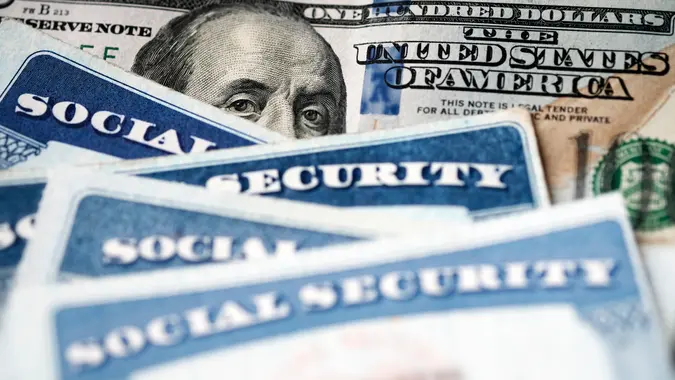
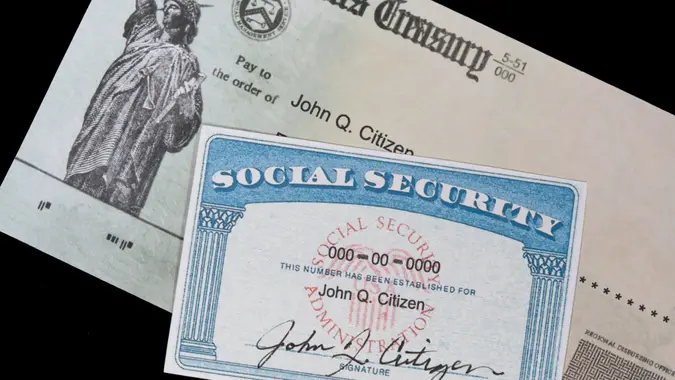
It’s understandable to think resources like Social Security are helpful for Americans with little saved for retirement. However, Social Security isn’t meant to replace your income in retirement.
Payments comprise approximately 40% of your pre-retirement earnings, according to the Social Security Administration (SSA). Furthermore, the SSA reports the average monthly Social Security payment is $2,071 as of January 2026. Relying solely on that amount can place significant budgetary strain on people with little saved for retirement.
Working after retirement is a possible solution, but it’s not without its own risks. If you’re younger than full retirement age (FRA) and earn more than the yearly earnings limit, the SSA will reduce benefits. That limit is $24,480 for 2026, according to the SSA. If you earn over that, the SSA deducts $1 in benefits for every $2 in earnings above the limit. For those past FRA, the SSA deducts $1 for every $3 in earnings above the limit, which is $65,160.
Other risks are present for those working, such as higher Medicare premiums, larger tax bills and more.
Next Steps
Statistics are helpful, but they can also guide your decision-making. Regardless of your age and where you stand with retirement planning, now is the time to make concrete plans.
Younger workers can assess their balances and increase their deferrals. Even increasing contributions by 1% annually can provide considerable benefits. When changing jobs, avoid the desire to cash out your 401(k) account. Instead, roll the old one over to your new 401(k) plan. If the new employer doesn’t offer one, consider moving it to a rollover IRA with an online broker.
Older workers still have time to plan, too. You can still make changes to grow your retirement savings. Speak with a financial advisor to identify the next steps to take to grow your retirement savings as much as possible before leaving the workforce.
Achieving a six-figure 401(k) balance is good. More Americans are doing it, but many are still without a retirement plan. Creating a worthwhile retirement plan is still possible for people who take action.
More From GOBankingRates
- Mark Cuban Just Exposed a Social Security Flaw That Every Senior Needs To Watch For
- What 2026 Senior Tax Deduction Means for Social Security and Retirement Planning
- How Middle-Class Earners Are Quietly Becoming Millionaires -- and How You Can, Too
- 6 Safe Accounts Proven to Grow Your Money Up to 13x Faster