I Asked a Car Expert: Will It Be Better To Buy a Used or New Car in 2026?
 Written by
Angela Mae Watson
Written by
Angela Mae Watson
 Edited by
Jenna Klaverweiden
Edited by
Jenna Klaverweiden
Commitment to Our Readers
GOBankingRates' editorial team is committed to bringing you unbiased reviews and information. We use data-driven methodologies to evaluate financial products and services - our reviews and ratings are not influenced by advertisers. You can read more about our editorial guidelines and our products and services review methodology.

20 Years
Helping You Live Richer

Reviewed
by Experts

Trusted by
Millions of Readers
A lot goes into buying a car. There are the upfront costs, of course, but you’ll also need to consider things like vehicle reliability, maintenance issues, future costs and personal preference.
One of the biggest questions you may be asking yourself is whether you should spend your money on a used or new car going into 2026. GOBankingRates spoke with two car experts — Melanie Musson with AutoInsurance.org and Chris Pyle with JustAnswer — which option they think is best.
Here’s what they said.
The Perks of Buying Used
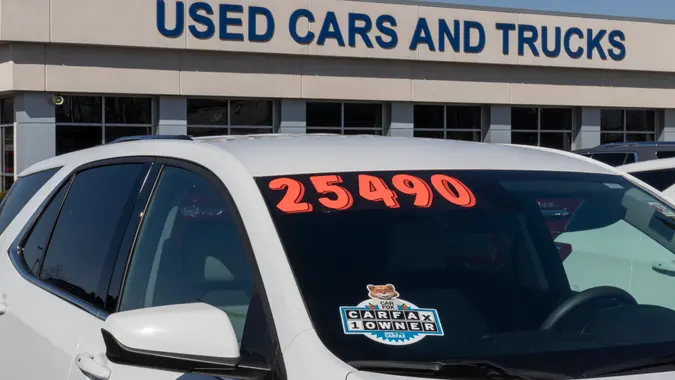
The average cost of a used vehicle is $25,945, according to Kelley Blue Book. That’s about half the cost of a new vehicle, which Kelley Blue Book reported is $50,080 on average.
But it’s not all about upfront costs. If you finance, monthly payments are also likely to be lower, meaning you could own the vehicle sooner than if you were to buy new.
You also get to skip out on some of that initial depreciation. “A used car has already experienced the fastest depreciation,” Musson said. “A car depreciates more in five years than it will in the next 10 years.”
New cars often lose around 55% of their initial value in the first five years, according to Kelley Blue Book. This means a 5-year-old car that was initially worth $50,080 would be worth closer to $22,500.
When you buy used, there’s the added advantage of knowing your vehicle isn’t perfect from the get-go, according to Pyle. The first time you get a small ding in your door, you’re less likely to be as upset as you would if that vehicle were brand-new.
With a used car, especially if you’re looking at a first-edition model, waiting a couple of years before you buy will also uncover any major issues with the vehicle. Just be aware of the vehicle’s history. “The good news is CARFAX often reports all past repairs, collisions, past owners and maintenance,” Pyle said.
The Perks of Buying New
Even though new vehicles are more expensive, there are reasons you might want to buy one anyway. The first is financing costs. According to Experian’s 2025 State of the Automotive Finance Market report, the average new car loan interest rate is 6.8%. It’s 11.54% for used vehicles.
And then there’s the excitement of simply owning a brand-new vehicle.
“Purchasing a brand-new car is very exciting and scary all at the same time. You are getting something no one else has ever owned,” Pyle said. “You are responsible for its highs and lows throughout the life of the car.”
New cars also come with their own warranty, which can give you peace of mind as you drive off the lot.
Note that used cars also often come with aftermarket warranties. You may need to purchase them separately, though. According to ConsumerAffairs, the average extended warranty ranges from $600 to $1,000 a year.
Bottom Line: Is It Better To Buy New or Used in 2026?
So should you buy a new vehicle or a used one in 2026? With inflation and tariffs, vehicle prices are likely to continue to rise in the coming months — and years. But it’s not only about costs.
“If you prefer to have the best-looking car, and no worry about the past, current or future, and your income can support a big car payment, then go for a new car,” Pyle said. “If you just do not like burning money on something that never gains value, and you can handle some repairs on your own as a DIYer, then go for a used car.”
Pyle said that he personally no longer buys new vehicles, as he prefers $0 or low payments and spending his money on other things. But what you choose is ultimately up to you.
Think about your budget. If you have any financial uncertainty going into next year, consider holding off on big purchases until you’re fully prepared for the upfront and ongoing costs.
More From GOBankingRates