I’m a Mechanic: 4 Hidden Repairs That Could Cost You Big
 Written by
David Nadelle
Written by
David Nadelle
 Edited by
Jenna Klaverweiden
Edited by
Jenna Klaverweiden
Commitment to Our Readers
GOBankingRates' editorial team is committed to bringing you unbiased reviews and information. We use data-driven methodologies to evaluate financial products and services - our reviews and ratings are not influenced by advertisers. You can read more about our editorial guidelines and our products and services review methodology.

20 Years
Helping You Live Richer

Reviewed
by Experts

Trusted by
Millions of Readers
It should go without saying, but delaying regular vehicle maintenance and routine repairs can result in expensive bills and on-the-road control risks, like tire blowouts and brake failures. However, it really shouldn’t come as a surprise that many drivers are putting off visiting the mechanic until they have the money to pay for it.
According to Kelley Blue Book, the national average cost for all types of repairs to all makes and models is $838. With auto loan payments averaging $748 per month (as of the third quarter of 2025), per Experian, an unexpected repair — or one known but postponed — can more than double your car expenses for the month.
Adding to your monthly bills and everyday expenses, a vehicle repair can be financially devastating. GOBankingRates asked Chris Pyle, auto specialist with the expert-on-demand platform JustAnswer, what he had to say about less common things that drivers don’t often think about until it’s too late.
Maintaining Your Car’s Oil
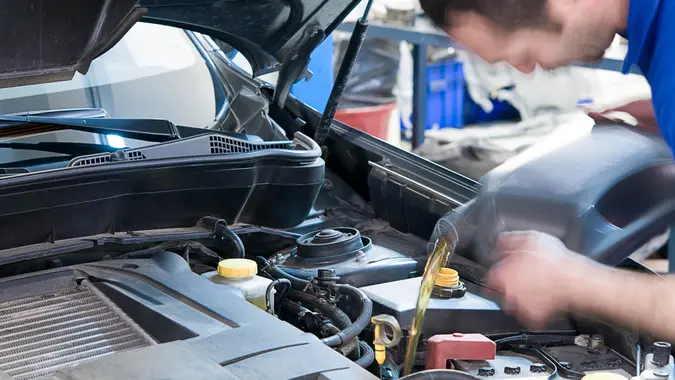
To use an already overplayed phrase, oil is the lifeblood of your engine. Unless you’re driving an electric vehicle (EV), you really should be comfortable with checking your oil level and doing it more frequently, especially if your car is getting on in years.
“No one checks the oil level before an oil change,” Pyle said. “You need to know if your car is consuming oil. If so, there is going to be a time when it gets too low that engine damage occurs, or even worse, the engine locks up, costing thousands.
“This goes beyond a leak occurring,” he added. “An engine can consume oil from a failing turbo, bad valve stem seals, a bad PCV valve, or worn-out piston rings and cylinder walls. The PCV is the only cheap fix; all of the others would be $1,000-plus to address.”
Checking Brake Lines and Pads
Oil might be a car’s lifeblood, but when it comes to safety, the brakes are arguably the most important part of your vehicle (along with the engine and tires). “Brake lines should be inspected for rubbing and rust areas. You also need to bleed the brakes at all four wheels to see the color of the fluid. If you find a rust color, a brake line is failing, and it will eventually rupture,” Pyle said.
High-pitched squeals, clicking, vibrating and underperforming braking will alert you to worn pads. And although you can try to visually inspect them, it’s better to take off the whole tire or take your car to the auto shop to fix them before they end up costing you more than they should.
“Once the pad is gone, the bare metal part will eat into the rotor, thus ruining the rotor,” Pyle said. “Often this overextends the caliper pistons, ruining them too. Also, the metal-to-metal contact emits hot metal particles that will burn into the wheels and ruin their appearance.
“A set of four pads for one axle can cost $80-$120 in parts only,” Pyle explained. “If you let them get too low, you can cause damage upwards of $600-$1,500 in parts and labor.”
Spotting Early Alignment Warning Signs
Yes, you should be exploring every nook and cranny of your car periodically for wear and tear. Pyle takes that hands-on approach further when it comes to alignment and tire inspection. “Each car owner at some point every other month should lie on the ground and take a look at all four tires to see the inboard and outboard sides and center,” he said.
Inspecting tires regularly can help car owners see potential issues. “Poor wearing tires means there are suspension and steering parts worn or bent,” Pyle said. “Repairs and an alignment are needed before you have a $600-$1,200 set of four tires fail way too early.”
If you see uneven wheel wear, feel your car pulling to one side or sense the steering wheel vibrating more than it should, seek out the professional opinion of a mechanic.
Keeping Your Vehicle Clean — Inside and Out
Newsflash: Cars are expensive! Spending a bundle on something you use a lot brings a certain level of responsibility. While some drivers treat their cars like rolling trash cans, most take pride in ownership, and having a clean car, inside and out, can help improve your outlook and a sense of accomplishment.
Americans who live in wintery states know the scourge of snow and salt on a car’s paint, but “paint scratches and rock dings” on dry-state cars can cost you a bundle too, according to Pyle. “If you do not treat those, rust will form. Then, large flakes of your paint will come flying off as you drive in the wind and rain. A $15 bottle of touch-up paint is better than needing to have the hood or roof repainted, which could be $800-$2,000,” he said.
Additionally, aside from the distractions a dirty and cluttered car can bring, leaving food in your car is an important and relatively simple thing to avoid. Animals gain access to the inside of your car more than you think, looking for shelter and an unexpected snack.
“Mice can find it,” Pyle said. “They will chew up insulation, seat foam, and wiring along the way as they make a home in your car, eating your leftover fast food stuck in the seat cracks. Also, the feces and urine odor is miserable to remove, often impossible. You can be left with a car you owe tens of thousands on that stinks to all persons that enter. Stop eating in your car if possible, and clean it more.”
More From GOBankingRates