Will Buying a Tesla Save Car Owners Big Money in 2026?
 Written by
Sean Bryant
Written by
Sean Bryant
 Edited by
Rebekah Evans
Edited by
Rebekah Evans
Commitment to Our Readers
GOBankingRates' editorial team is committed to bringing you unbiased reviews and information. We use data-driven methodologies to evaluate financial products and services - our reviews and ratings are not influenced by advertisers. You can read more about our editorial guidelines and our products and services review methodology.

20 Years
Helping You Live Richer

Reviewed
by Experts

Trusted by
Millions of Readers
Now that we are officially in 2026 and following recent EV incentive changes under Trump’s “One Big Beautiful Bill” Act (OBBBA), U.S. car buyers are wondering if an electric vehicle (EV), such as a Tesla, will truly save them money. Find out below.
How Does Trump’s OBBBA Change EV Tax Incentives?
Trump signed OBBBA in 2025, making big changes to the incentives for buying EVs in the US. Basically, it eliminates the previous $7,500 federal EV tax credit and replaces it with a new vehicle loan interest deduction, according to American Progress.
OBBBA’s goal was to introduce a “Buy American” incentive. Buyers financing a new vehicle assembled in the U.S. (such as Teslas) can deduct up to $10,000 in auto loan interest on their taxes. This makes the interest on a Tesla loan tax-deductible, which can potentially save you a few hundred to a few thousand dollars over the life of the loan.
Tesla vs. Gas Costs
EV drivers spend about 60% less on fuel compared to gas car drivers, according to a report by Consumer Reports. A 2018 analysis by Forbes found that drivers spend around $485 per year for electricity versus $1,117 per year for gasoline on average.
EVs also don’t need to have their oil changed or go through as many of the routine services that gas cars do. Per Atlas Public Policy, maintenance and repair costs are 40% lower per mile for EVs than for gas cars ($1,200 versus $500).
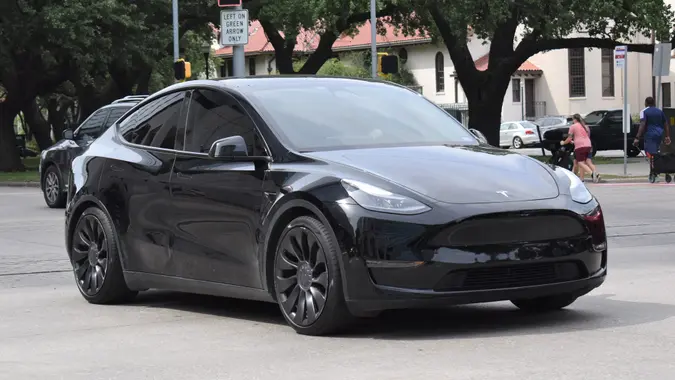
The table below compares a Tesla Model Y with a similar gasoline SUV’s expenses, assuming 12,000 miles driven per year, electricity is around 14 cents/kWh and gasoline is at $3.50/gal.
| Tesla Model Y | Comparable Gas SUV | |
| Car price | $39,990 to $57,490, per Find My Electric ($45,000 average) | $40,000 average, per iSeeCars |
| Federal EV tax credit | $0 (credit expired) | $0 |
| Fuel / Electricity | $2,500 | $7,500 |
| Maintenance | $2,500 | $6,000 |
| Final costs after 5 years | ~$50,000 | ~$53,500 |
The new OBBBA interest deduction can further tip the scales in your favor if you finance your Tesla.
EV Industry Outlook for 2026 Under the New Policy
Removing the federal tax credit makes EVs relatively more expensive and could slow down EV sales growth in the short term. Additionally, the new law eliminated federal fuel-economy (CAFE) penalties for automakers, meaning companies no longer face fines for selling gas guzzlers, which reduces the pressure to produce EVs or high-MPG models.
But there are still plenty of indicators that suggest the EV momentum will continue. Market forces and technology are still moving in favor of EVs and the gap between EV and gasoline vehicle purchase costs continues to shrink to just $3,000 to $8,000 (per SolarTech), with no sign of slowing down as battery prices get cheaper and cheaper. Not to mention, fuel and maintenance costs for EVs are still so much lower than those for gas cars.
Can You Still Save Money Buying a Tesla?
While Trump’s tax bill removed a major perk for EVs, it is unlikely to stop the EV industry’s growth in 2026. This is because EVs are still economical. The longer you own a Tesla, the more the savings compound. After the break-even point is reached in a few years, every year of driving electric is money in your pocket. These operational savings are why many owners still find EVs economical in the long run, despite higher purchase prices and the lack of a federal tax credit.
More From GOBankingRates