4 Stores That Will Charge You a Fee for Getting Cash Back and 5 Others That Won’t
 Written by
Rebecca Neubauer
Written by
Rebecca Neubauer
 Edited by
Rebekah Evans
Edited by
Rebekah Evans
Commitment to Our Readers
GOBankingRates' editorial team is committed to bringing you unbiased reviews and information. We use data-driven methodologies to evaluate financial products and services - our reviews and ratings are not influenced by advertisers. You can read more about our editorial guidelines and our products and services review methodology.

20 Years
Helping You Live Richer

Reviewed
by Experts

Trusted by
Millions of Readers
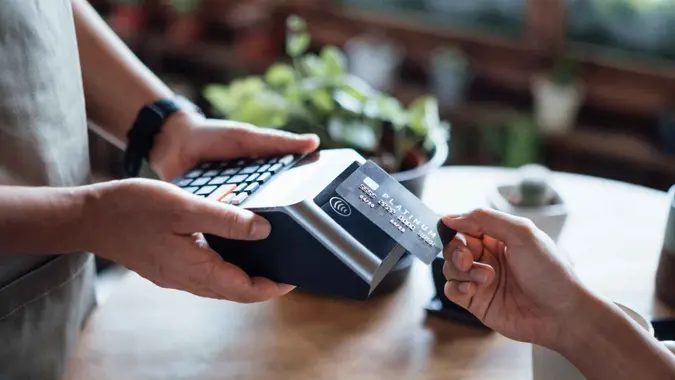
Getting cash back while you’re shopping isn’t just convenient — in areas where bank access is limited, it’s essential. As bank branches close and out-of-network ATM fees rise, more people are turning to retail stores to receive cash back at checkout. While cash back was once a free convenience, several major retailers have started to charge fees for cash back transactions, as reported on MSN.
Why Stores Are Charging Cash Back Fees
The shift towards charging fees for cash back services is driven by several factors. According to a report by the Consumer Financial Protection Bureau (CFPB), Americans are paying over $90 million in fees annually to access their own money at large retail stores.
“While retail chains had long provided cash back on debit card purchases for free, the CFPB has found that dollar store chains and other retailers are now charging fees for access to cash,” said CFPB Director Rohit Chopra. “Many people living in small towns no longer have access to a local bank where they can withdraw money from their account for free. This has created the competitive conditions for retailers to charge fees for cash back.”
For retailers, charging cash back fees can offset the costs associated with processing transactions. However, for consumers, especially those in small towns or low-income areas, these fees represent an additional financial burden. The CFPB’s report highlighted that consumers with lower incomes or fewer banking choices are disproportionately affected by these fees, as dollar stores are often located in rural or underserved communities.
The following four stores charge a fee for cash back transactions.
Family Dollar
Family Dollar, a popular chain known for its budget-friendly items, has recently implemented a fee for cash back transactions. Shoppers at Family Dollar are charged $1.50 for cash back amounts under $50, according to CFPB. This fee can be a significant percentage of the withdrawal amount, especially for those who need only small sums of cash.
Dollar Tree
Dollar Tree, which is owned by the same parent company as Family Dollar, has also introduced cash back fees. Dollar Tree also charges $1 for cash back transactions under $50. This move aligns with a broader trend among dollar store chains to monetize services that were previously free.
Dollar General
Dollar General has joined the ranks of retailers charging for cash back services. Mystery shopping at Dollar General by CFPB in 2022 indicated that the fee could be $1 to $2.50 per withdrawal up to $40, varying by location and other variables. Given that Dollar General stores are often located in rural or low-income areas, the introduction of these fees can disproportionately affect consumers who already have limited access to banking services.
Kroger
Kroger, the largest grocery chain in the U.S., has also started to charge for cash back services, though its fees are lower and limits higher than the dollar stores. At Kroger’s Harris Teeter stores, the fee is 75 cents for cash back amounts of $100 or less and $3 for withdrawals of $100 to $200. At other Kroger brand stores, such as Ralph’s and Fred Meyer, the fee is 50 cents for up to $100 cash back and $3.50 for withdrawals between $100 and $300.
5 Stores That Don’t Charge Cash Back Fees
If you’re looking to avoid paying cash back fees, you can withdraw money at these stores without paying a cash back fee:
- Up to $20 at Walgreens
- Up to $40 at Target
- Up to $60 at CVS
- Up to $100 at Walmart
- Up to $200 at Albertsons
However, these stores may not be available in smaller towns, which already struggle with bank accessibility.
More From GOBankingRates