4 Tax Breaks You Might Miss If Trump’s Plan Changes Again
 Written by
Travis Woods
Written by
Travis Woods
 Edited by
Rebekah Evans
Edited by
Rebekah Evans
Commitment to Our Readers
GOBankingRates' editorial team is committed to bringing you unbiased reviews and information. We use data-driven methodologies to evaluate financial products and services - our reviews and ratings are not influenced by advertisers. You can read more about our editorial guidelines and our products and services review methodology.

20 Years
Helping You Live Richer

Reviewed
by Experts

Trusted by
Millions of Readers
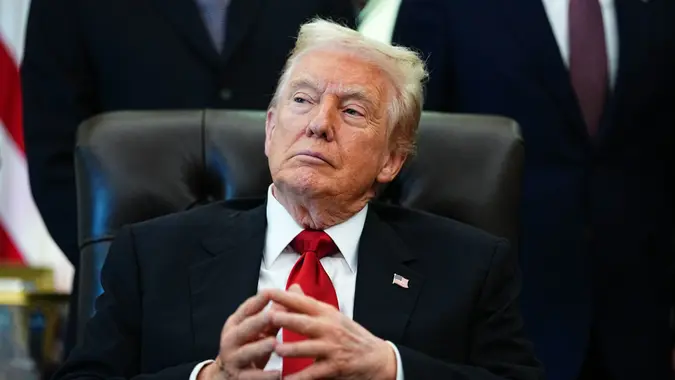
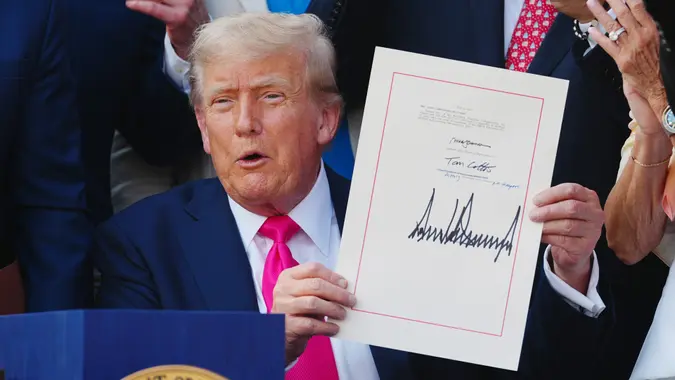
President Donald Trump’s One Big Beautiful Bill Act (OBBBA) will likely be remembered as one of the most consequential actions of his first year back in office. Signed into law in 2025, the OBBBA set the economic agenda for Trump’s second administration with a sweeping number of provisions, extensions and discontinuations to the American tax code, many of which have been criticized for primarily benefitting America’s top 10% of earners while financially harming the lowest 10%.
While Trump fought intensely to get the bill passed, he is also something of a mercurial president and known to change his mind. While not overwhelmingly likely, it’s possible that midterm voters’ potentially negative reactions to Trump’s agenda might sway the president into further changing the tax code. Additionally, there are temporary tax breaks that might disappear if legislation is not enacted to preserve or extend them — tax breaks your wallet could sorely lament should they disappear.
With that in mind, below are five tax breaks that you might miss should President Trump’s financial agenda change again.
Standard Deductions
The standard tax deduction isn’t a permanent rule — it exists because lawmakers have set it. The current standard deduction of $15,750 for single filers, $31,500 for married couples filing jointly and $23,625 for married couples filing separately was originally set by the Tax Cuts and Jobs Act (TCJA) of 2017 and it was set to expire after 2025, until the OBBBA extended it. However, Congress could always change the standard deduction with new legislation or repeal elements of the OBBBA that allowed it to survive past 2025. Further, if President Trump were to allow these TCJA deductions to expire, a number of households would miss them.
SALT Deductions
The State and Local Tax (SALT) deduction, which allows taxpayers to deduct specific state and local taxes from their federal taxable income, was raised in 2025 from $10,000 to $40,000. It is already set to reduce back to $10,000 in 2030. If legislation is not put into place to preserve the SALT cap at $40,000, a number of homeowners in the middle-to-upper income brackets in the affected states would be impacted.
‘No Tax on Tips’
Currently, workers with certain tip-friendly gigs can exclude up to $25,000 of tip-based income annually the tax years of 2025, 2026, 2027 and 2028. While Trump himself cannot repeal this tax law unilaterally, were he to press Congress to do so, the result could be devastating for workers whose finances are kept afloat by tips.
Senior Tax Deductions
Currently, taxpayers over the age of 65 are able to apply an additional deduction (atop the standard deduction) of $2,000 for single filers and $1,600 per spouse for married joint filers. Additionally, thanks to the OBBBA, there is an secondary temporary senior bonus deduction running from 2025 to 2028, in which seniors over the age of 65 can claim an additional deduction of $6,000 per person on their federal tax returns. Should Trump allow it to expire in 2028 by not pressing for preemptive legislation to extend this bonus deduction, many seniors who have grown used to an extra $6,000 deduction per year will sorely miss it.
Need a little extra breathing room in your budget? MoneyLion, a sister company of GOBankingRates, is giving away $2,000 a day through Jan. 24, 2026. Sign up here and see if a cash boost is in your future.
Editor’s note on political coverage: GOBankingRates is nonpartisan and strives to cover all aspects of the economy objectively and present balanced reports on politically focused finance stories. You can find more coverage of this topic on GOBankingRates.com.
More From GOBankingRates