Are Union Dues Tax-Deductible? Rules, Exceptions and What To Know
 Written by
Rudri Bhatt Patel, CFHC™
Written by
Rudri Bhatt Patel, CFHC™
 Edited by
Elizabeth Constantineau, CFHC™
Edited by
Elizabeth Constantineau, CFHC™

Commitment to Our Readers
GOBankingRates' editorial team is committed to bringing you unbiased reviews and information. We use data-driven methodologies to evaluate financial products and services - our reviews and ratings are not influenced by advertisers. You can read more about our editorial guidelines and our products and services review methodology.

20 Years
Helping You Live Richer

Reviewed
by Experts

Trusted by
Millions of Readers
Union dues are not tax-deductible on federal returns — unless you’re self-employed. The Tax Cuts and Jobs Act (TCJA) of 2017 eliminated the federal tax deduction for union dues, and it hasn’t returned. However, self-employed workers may still qualify in some states, so it’s worth checking with a financial advisor to see if state-level deductions apply.
Quick Eligibility Snapshot
- Self-employed: Eligible to deduct union dues as a business expense
- W-2 employee: Not eligible for a federal deduction
- State return: Possible deduction under state law
- Claiming the deduction: Requires reporting union dues on Schedule C (Form 1040) and keeping proof of payment
What Are Union Dues?
Union dues are fees that members pay to keep their union running. These funds typically cover the union’s operations, such as negotiations, member support and administrative costs. Union dues are generally 1% to 2% of an employee’s salary, but this amount could change depending on the industry, union and location.
Are Union Dues Tax-Deductible on Federal Returns?
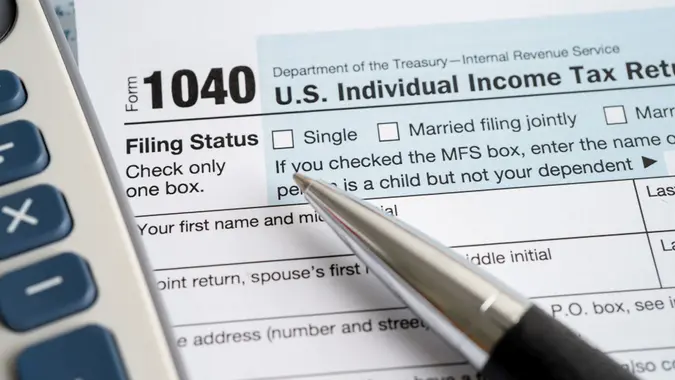
No, union dues are not tax-deductible on federal tax returns. The one exception is if you’re self-employed. You can deduct union dues as a business expense on Schedule C (Form 1040).
Who Can Still Deduct Union Dues?
You can deduct union dues in two scenarios:
- If you’re self-employed, you can claim them on your federal tax return.
- Some states allow deductions for union dues on state tax returns.
Self-Employed Workers
Under the TCJA of 2017, employees could no longer deduct union dues as miscellaneous itemized deductions for tax years 2018 through 2025. As of 2026, Congress has not reinstated the deduction and union dues remain non-deductible for most employees.
The one exception is for self-employed workers, who can deduct union dues as a business expense on Schedule C.
State-Level Deductions
Some states allow for the deduction of union dues on state tax returns, either as itemized deductions or adjustments to income.
Some examples include:
- Maryland
- Delaware
- Hawaii
- Oregon
To see if your state allows it, you can check the National Conference of State Legislatures’ database.
How To Deduct Union Dues
Before you begin, make sure you have documentation of all union dues paid throughout the year. This information is often included on your paycheck or provided by your union at year’s end.
Federal for Self-Employed Workers
If you’re self-employed, here’s how to deduct union dues on your federal return:
- Step 1: Complete Schedule C as part of your tax return.
- Step 2: In Part II of Schedule C, list union dues under “Other Expenses” or “Dues and Subscriptions,” if applicable.
- Step 3: Report the total amount of union dues paid for the year.
State Returns
If your state allows deductions for union dues, the process typically involves:
- Step 1: Check if your state tax return includes a section for itemized deductions or unreimbursed employee expenses.
- Step 2: List the total amount of union dues paid on the relevant line of your state tax form.
- Step 3: Attach any additional forms or schedules your state requires to claim these deductions.
Other Tax Breaks Union Members May Qualify For
Although most union members can’t deduct union dues, there are other tax breaks that may still be applicable.
| Tax Break | Who Qualifies | Federal or State |
Amount / Benefit |
|---|---|---|---|
| Lifetime learning credit | Union members taking job-related courses or trainings | Federal | -Up to $2,000 per year |
| Retirement contributions | Individuals with access to retirement accounts | Federal | -Lowers taxable income |
| Health and medical expenses | Workers with union health plans | Federal | –HSA or FSA tax savings -Deduct expenses above 7.5% of AGI |
Pros and Cons of Deducting Union Dues
Before you deduct union dues, it’s worth weighing the potential benefits and drawbacks.
Pros
- Reduces taxable income: Deducting union dues will reduce a taxpayer’s taxable income.
- Encourages union participation: Having deductible union dues may encourage more individuals to join a union.
- Offsets membership costs: The deduction can offset the costs of the union’s membership dues.
Cons
- Doesn’t apply to standard deductions: Most people use the standard deduction, and to get the union dues deducted, you would have to itemize your deductions.
- More calculations and paperwork: Itemizing your union deduction will add more paperwork and time to your taxes.
Final Take
- Union dues are not deductible on federal returns for most employees.
- Self-employed workers can still deduct union dues as a business expense on Schedule C.
- Some states allow union dues deductions, but rules vary.
- Although the TCJA provision has expired, Congress has not reinstated the deduction.
Union Dues FAQ
Got questions about union dues and taxes? Here are quick answers to some of the most common ones:- Are union dues deductible for retirees?
- Union dues are not tax-deductible for retirees on a federal tax return — unless the individual is self-employed. Certain states, however, allow for a state tax deduction.
- Why are union dues no longer deductible?
- In 2017, TCJA enacted legislation prohibiting union dues from being tax-deductible.
- Can I deduct union dues on state taxes?
- Yes, certain states allow you to deduct union dues from your state tax returns.
- Are initiation fees treated differently?
- No. Union initiation fees are treated the same as regular union dues and are not deductible on federal tax returns unless you are self-employed.
- Will union dues be deductible again after 2025?
- While the TCJA provision expired after 2025, Congress has not restored the deduction, so union dues remain non-deductible for most employees.
Our in-house research team and on-site financial experts work together to create content that’s accurate, impartial, and up to date. We fact-check every single statistic, quote and fact using trusted primary resources to make sure the information we provide is correct. You can learn more about GOBankingRates’ processes and standards in our editorial policy.
- Bureau of Labor Statistics. 2024. "UNION MEMBERS — 2023."
- Union Plus. "How Unions Work."
- NCSL. 2024. "Some States Strengthened, Others Limited Collective Bargaining in 2023."
- IRS. 2025. "Tax Cuts and Jobs Act: A comparison for businesses."