Warren Buffett’s 2013 Stock-Buying Test Is More Relevant Than Ever in 2026
 Written by
Vance Cariaga
Written by
Vance Cariaga
 Edited by
Jenna Klaverweiden
Edited by
Jenna Klaverweiden

Commitment to Our Readers
GOBankingRates' editorial team is committed to bringing you unbiased reviews and information. We use data-driven methodologies to evaluate financial products and services - our reviews and ratings are not influenced by advertisers. You can read more about our editorial guidelines and our products and services review methodology.

20 Years
Helping You Live Richer

Reviewed
by Experts

Trusted by
Millions of Readers
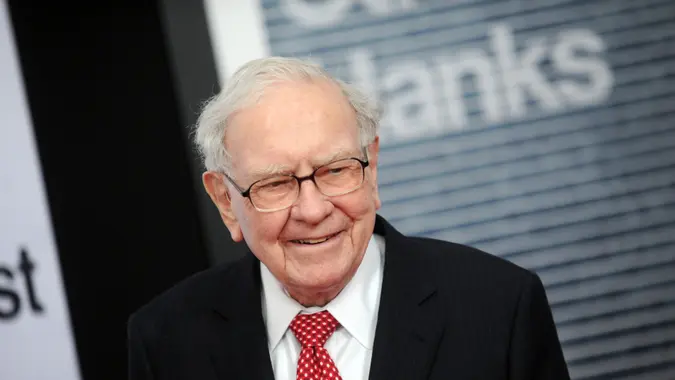
Warren Buffett has shared a lot of stock market wisdom over the years that investors continue to take to heart. Among his most important tips were included in a 2013 letter to shareholders of Berkshire Hathaway.
In the letter, he mentioned a stock-buying test that he and Charlie Munger adopted. Here’s the short version:
- Decide whether you can “sensibly” estimate a company’s earnings range for the next five-plus years. If so, buy the stock — but only at a “reasonable” price.
- If you can’t estimate future earnings, “move on to other prospects.”
- Don’t ever skip a good buying opportunity based on the macro or political environment, or the views of other people.
Here’s a look at why that stock-buying test is more relevant than ever in 2026.
The Earnings Picture
The U.S. stock markets have been on a record-setting run for more than three years. That run has continued in 2026 — largely because of the kind of positive earnings environment that Buffett spotlighted in 2013.
An “improving” corporate earnings outlook is reflected in “steadily rising” estimates,” according to a recent report from Zacks Investment Research. In fact, total S&P 500 earnings are expected to grow by 12.9% in 2026, with that number falling to 9.3% when the tech sector is taken out.
Political Environment
The U.S. geopolitical environment is anything but stable so far in 2026. But many investors seem to have taken Buffett’s advice by ignoring political tensions and buying stocks.
Despite some stock market tumult early in 2026, as of Feb. 12, the S&P 500 was up by about 1.35% for the year, while the Dow had gained 3.96%. That’s the case even though tensions have risen abroad and at home in 2026.
“What markets are saying is that unless it’s a variable that really alters consumer or business activity, there isn’t really much of a broad-based reaction across more traditional asset classes,” said Eric Freedman, chief investment officer at Northern Trust Wealth Management, said in an interview with Marketplace.
Macro Environment
For the most part, investors seem to be taking Buffett’s advice by not letting the macro environment dictate their stock decisions.
For proof, look at the reaction after news hit that the Justice Department opened a criminal investigation into the Federal Reserve and Fed Chairman Jerome Powell. The S&P 500 initially tanked on Monday, Jan. 12, but reversed course and ended the day at an all-time high, CNBC reported.
Meanwhile, the economy is sending the kind of mixed signals that usually lead to a wary stock market.
Although inflation has slowed recently, consumer prices remain historically high — and 2026 probably won’t bring much relief, according to Charles Schwab. The latest Federal Reserve data show that consumer confidence is hovering near its lowest point since July 2022.
The job market has also shown worrying signs. In 2025, employers announced over 1.2 million job cuts — up 58% from 2024, according to an analysis from Challenger, Gray & Christmas. Annual job cuts are at their highest point since 2020.
Despite these macro headwinds, investors remain focused on the kinds of business fundamentals that Buffett values.
Editor’s note: This article is for informational purposes only and does not constitute financial advice. Investing involves risk, including the possible loss of principal. Always consider your individual circumstances and consult with a qualified financial advisor before making investment decisions.
More From GOBankingRates