Elon Musk and 4 Other CEOs Investors Should Pay Attention To When Buying Stocks
 Written by
Vance Cariaga
Written by
Vance Cariaga
 Edited by
Jenna Klaverweiden
Edited by
Jenna Klaverweiden
Commitment to Our Readers
GOBankingRates' editorial team is committed to bringing you unbiased reviews and information. We use data-driven methodologies to evaluate financial products and services - our reviews and ratings are not influenced by advertisers. You can read more about our editorial guidelines and our products and services review methodology.

20 Years
Helping You Live Richer

Reviewed
by Experts

Trusted by
Millions of Readers
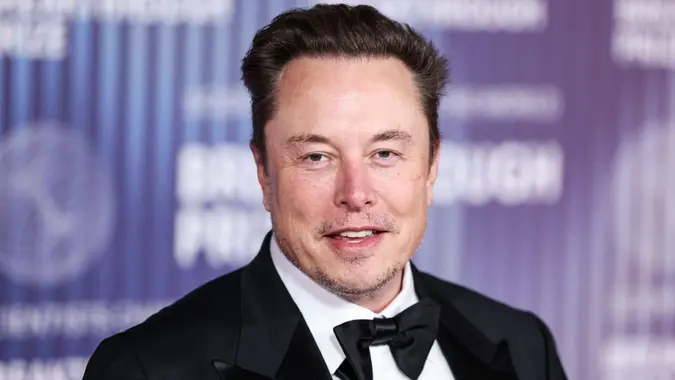
All CEOs play a big role in how a company performs, but some have a much bigger impact than others.
Look no further than Elon Musk, the CEO of Tesla and world’s richest person. Musk recently got a new incentive-laden pay package that could make him the world’s first trillionaire. This could tell you that Tesla board members (and many investors) see Musk as the company’s most valuable asset and are willing to pay him a princely sum to steer Tesla into the future.
Which CEOs should investors pay attention to when buying stocks? Here’s a look at Musk and four others.
Also see how CEOs and other executives really get rich.
1. Elon Musk, Tesla (TSLA)
- CEO start date: October 2008
- One-year gain/loss (as of Feb. 13): 17.91%
- Net worth (as of Feb. 13): $850.2 billion
Musk is the world’s richest person with a net worth of $850.2 billion as of Feb. 13. Meanwhile, Musk’s new pay package is a testament to his ability to convince investors that he has the golden touch as a CEO even though Tesla has run into some headwinds of late.
Tesla has seen sluggish revenue growth, declining earnings and issues with its self-driving technology. “Big Short” investor Michael Burry recently called Tesla’s stock “ridiculously overvalued,” The Motley Fool reported.
So why does Tesla’s stock (and Musk’s riches) keep pushing higher?
“[A lot] depends on whether you think Tesla is a car company, a tech company or something else entirely,” Edward Corona, founder of The Options Oracle AI Trade Manager, told GOBankingRates in a previous article. “If you’re betting on Elon, you’re betting on a guy who’s delivered moonshots before, but you’re also signing up for turbulence. That’s just the trade-off.”
2. Jensen Huang, Nvidia (NVDA)
- CEO start date: April 1993, when he co-founded Nvidia
- One-year gain/loss (as of Feb. 13): 36.09%
- Net worth (as of Feb. 13): $160 billion
You don’t have to dig too deep to understand Huang’s importance as a CEO, considering the stock’s massive growth.
Even if you don’t own shares of Nvidia, most investors “indirectly do” because of the company’s heavy weighting in the S&P 500, according to Vince Stanzione, founder and CEO at First Information and author of “The Millionaire Dropout.”
“The whole tech sector and AI hang on every word Huang says,” Stanzione told GOBankingRates. “When he speaks, he can easily move the stock by 5%+, which in turn takes the S&P 500 with it.”
3. Hock Tan, Broadcom (AVGO)
- CEO start date: March 2006
- One-year gain/loss (as of Feb. 13): 39.52%
- Net worth (as of September 2025): $1.2 billion
Tan earns high marks for transforming Broadcom from a run-of-the-mill semiconductor business into a “technology powerhouse,” according to Joseph Shaposhnik, CEO of Rainwater Equity and portfolio manager on the Rainwater Equity ETF.
“After acquiring over a dozen semiconductor companies, he [pivoted] the business to acquiring and building software businesses, culminating in his epic acquisition of VMware,” Shaposhnik said. “He repositioned a legacy custom ASIC business to build TPUs (tensor processing units), which could generate $80 billion of revenues by 2030.”
4. Jamie Dimon, JPMorganChase (JPM)
- CEO start date: January 2006
- One-year gain/loss (as of Feb. 13): 9.83%
- Net worth (as of Feb. 13): $2.8 billion
Dimon remains one of the “most watched non-tech CEOs,” Stanzione said.
That’s largely because of Dimon’s annual shareholder letters, economic forecasts and policy commentary that often move “not just JPMorgan’s stock but banking sector indices.”
5. Lisa Su, Advanced Micro Devices (AMD)
- CEO start date: October 2014
- One-year gain/loss (as of Feb. 13): 86.61%
- Net worth (as of Feb. 13): $1.4 billion
Su “rescued” AMD from “near collapse” when she took over as CEO in 2014, according to Stanzione.
“Investors react strongly to her product roadmaps, and she is, in my view, the leading female CEO in technology and AI,” he said. “She is one CEO to keep watching in 2026.”
Editor’s note: This article is for informational purposes only and does not constitute financial advice. Investing involves risk, including the possible loss of principal. Always consider your individual circumstances and consult with a qualified financial advisor before making investment decisions.
More From GOBankingRates