Former Menards Employee Reveals Why This First Job Is a Crash Course in Money Management
 Written by
Jake Safane
Written by
Jake Safane
 Edited by
Zuri Anderson
Edited by
Zuri Anderson
Commitment to Our Readers
GOBankingRates' editorial team is committed to bringing you unbiased reviews and information. We use data-driven methodologies to evaluate financial products and services - our reviews and ratings are not influenced by advertisers. You can read more about our editorial guidelines and our products and services review methodology.

20 Years
Helping You Live Richer

Reviewed
by Experts

Trusted by
Millions of Readers
Your first job is likely your lowest-paying job, but it can also teach you life lessons that set you up for future financial success. Especially if you work in a high-traffic sector like retail or restaurants, you’re likely to run into people from all walks of life who can give you a crash course in money management.
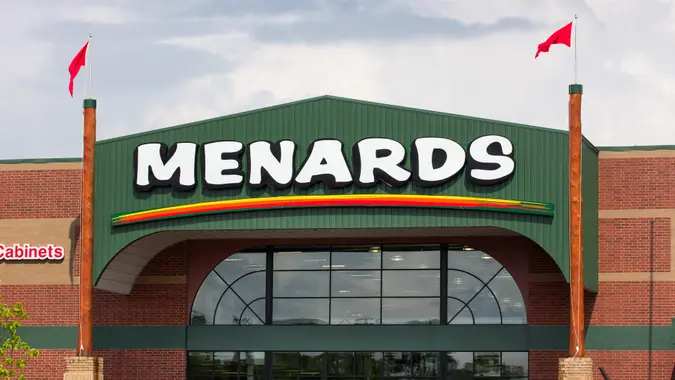
For David Wurst, owner of digital marketing company WebCitz, working his first job at Menards — a big-box home improvement store popular in the Midwest — helped him learn what not to do when it comes to personal finance.
In particular, while working in the plumbing department at Menards in high school in 2004-2005, Wurst spent some time rotating with other employees at the credit card kiosk. There, customers would apply for store cards, and Wurst often got their life stories while they filled out an application, and he entered it into the system to see if they’d get approved.
“The number of people I talked to and helped sign up for a credit card that clearly shouldn’t be given a credit card was astounding,” he said.
Trapped in Bad Debt
Wurst’s big takeaway from handling those credit card applications was that credit cards can get you into trouble if you don’t manage them carefully.
When you’re young, you might think of credit cards or other types of debt as essentially free money or a gift of sorts to buy you time to enjoy life now and worry about it later. The problem, though, is that once you get started in a debt cycle, it often only gets harder to break free as time passes and interest accrues.
So, interacting with customers in unenviable positions helped Wurst understand this risk.
“Countless people asked if they would be approved if they had a bad credit score or a recent bankruptcy,” he said.
While there might be extenuating circumstances where adding a credit card in that type of situation makes sense, it often means that you’re compounding the problem or setting yourself up for another case of being unable to pay your balance.
Eventually, that catches up to you.
For example, Wurst started working at Menards around the time when they added a grocery section. He recalled one customer asking if they could buy food using the credit card and asked how long it would take to get the credit card.
While Menards was able to do same-day approvals and usage, so a customer could use it on groceries in this case, imagine if you’re in a situation where you’ve maxed out your cards, your credit score is too low to get any more approvals, and you need to buy food for your family. You can only outrun debt for so long before you can no longer purchase even the essentials.
That’s not to say debt is always bad. Sometimes it’s necessary to get you through a rough patch, and it can even be a strategic financial move, like if you can borrow money at a low rate while keeping more in savings or investments earning a higher return.
Yet that didn’t seem to be the case at Menards.
“I don’t ever remember someone signing up and being interested in the extended period of low-interest or zero-percent interest financing, as if to finance a renovation,” Wurst said.
Making the Most of Your Time
In addition to seeing and hearing about the financial mistakes customers often made to land themselves in difficult situations, Wurst also got some first-hand experience on the other side of the equation, in terms of figuring out ways to make more money.
When he had downtime, he found ways to be productive and sowed the seeds for the web development business he started after working at Menards. In particular, he said he used to draw website layouts on scratch paper.
“As a high school kid, I often worked shifts of six to close, so the stores weren’t incredibly busy at night. It helped pass the time of waiting for the next guest to come into the store,” explained Wurst.
You don’t have to seek productivity 24/7, but there’s a good chance that your first job can also help set you up for higher future earning potential. That might mean taking advantage of downtime like Wurst, or it might mean leaning into skills development on the job.
Maybe you want to get into social media marketing, and the local restaurant you work for lets you help run their Instagram and TikTok channels. Or maybe you’re working as an office receptionist, and you gain access to software tools that help you become more qualified for your next job.
Overall, making the most of your time at your first job, both from learning from colleagues and customers, as well as furthering your own learning and development, can go a long way toward helping your future finances.
More From GOBankingRates