Here’s What It Costs To Charge a Tesla Monthly vs. Using Gas for a Nissan Frontier
 Written by
Sean Bryant
Written by
Sean Bryant
 Edited by
Zuri Anderson
Edited by
Zuri Anderson
Commitment to Our Readers
GOBankingRates' editorial team is committed to bringing you unbiased reviews and information. We use data-driven methodologies to evaluate financial products and services - our reviews and ratings are not influenced by advertisers. You can read more about our editorial guidelines and our products and services review methodology.

20 Years
Helping You Live Richer

Reviewed
by Experts

Trusted by
Millions of Readers
Clean air, better health and great value — electric vehicles (EVs) promise all of this and more, with many drivers noticing the significantly lower fuel costs that come with owning an EV.
But how much cheaper are they compared to gas vehicles like the Nissan Frontier?
Monthly Cost of Charging a Tesla at Home
No one ever said, “I can’t wait to stop at the gas station after work.” Between crowded pumps, germ-infested grimy handles and soaring prices, it’s hardly anyone’s favorite errand.
Now, replace that with a single step. Instead of waiting in line, you plug in your car, go to bed and wake up to a full “tank.” Charging a Tesla at home is one of the simplest (and most satisfying) perks of owning an EV.
Most Tesla models consume between 25 and 30 kWh per 100 miles, according to Cars.com. With the average U.S. household electricity rate costing $0.16 per kWh (and even less overnight), you will spend around $4 to $5 to drive 100 miles, per Ecoflow.
If you drive 1,000 miles per month, your Tesla’s monthly charging bill will be between $40 and $55, which is considerably less than fueling a comparable gas sedan.
Now, of course, the exact figure largely depends on local utility rates and the Tesla model. For example, a Model 3 Standard Range uses less power than a Model X SUV. But across models and states, electricity consistently outpaces gasoline in both cost efficiency and predictability.
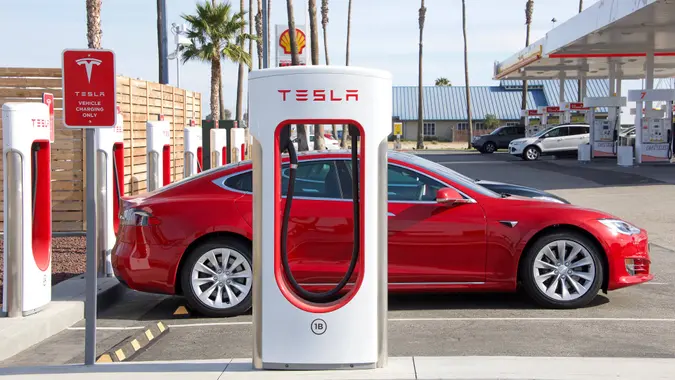
Unfortunately, charging at home is not a luxury we can have every time our cars need juice. At some point or another, you might find yourself using public fast charging through Tesla’s Supercharger network. This is more expensive, averaging $0.28 to $0.32 per kWh, or roughly $90 per month for similar mileage.
Traditional Power Costs with the Nissan Frontier
Gas prices rise and fall largely in response to changes in crude oil prices and the balance between supply and demand. They can also change quickly when factors such as refinery outages, distribution issues or seasonal fuel requirements affect the amount of gasoline available to the market.
And when those price swings hit, they can make a real difference at the pump, especially for larger vehicles like the Nissan Frontier.
The Frontier averages roughly 20 miles per gallon, the U.S. Department of Energy reported. If you were to drive 1,000 miles a month, it would burn close to 50 gallons of fuel, and with the national average cost being $3.02 per gallon, that’s $151 per month, according to the U.S. Energy Information Administration (EIA). Compared to $40 to $55 for electricity, $151 dollars is looking mighty high.
Plugging In Pays Off
Understandably, trucks serve different purposes than electric vehicles. You wouldn’t expect an EV to be able to have the towing capacity or hauling power a truck has. So if you’re buying the Frontier for work or heavy-duty use, then it’s completely worth it.
But if you’re going to be driving exclusively in the city and don’t need all the features that come with owning a truck, a Tesla will give you much more savings at the plug than any gas tank can match.
More From GOBankingRates