Why Energy Experts Say 3 Utility Changes Are Worth Paying for (and One Isn’t)
 Written by
Sarah Li Cain
Written by
Sarah Li Cain
 Edited by
Cory Dudak
Edited by
Cory Dudak
Commitment to Our Readers
GOBankingRates' editorial team is committed to bringing you unbiased reviews and information. We use data-driven methodologies to evaluate financial products and services - our reviews and ratings are not influenced by advertisers. You can read more about our editorial guidelines and our products and services review methodology.

20 Years
Helping You Live Richer

Reviewed
by Experts

Trusted by
Millions of Readers
If your energy bills feel high, you might be tempted to opt for a solution requiring a substantial financial investment. However, energy pros say the smartest upgrades aren’t typically all that expensive.
When you make the following expert-recommended fixes to your home, you’ll be saving money in the long run while lowering costly energy bills. Just beware one major home upgrade that could be more pricey than beneficial.
1. Insulation
Caleb Caviness, general manager of AryCo, said homeowners need to think about how to address foundations that help with energy efficiency.
“Homeowners need to change their mentality from trying to add more water to a leaky bucket, and instead focus on plugging the holes,” he explained. “If your energy bill is higher than average, instead of getting solar panels to lower the cost, focus on proper insulation first.”
He noted that upgrades to insulation such as sealing gaps in windows can offer a return on your investment within a few years.
Jon Gilbertsen, president at Chris Heating & Cooling, agreed that insulation is a worthwhile investment.
“Uninsulated walls are one of the biggest sources of heat loss in a home,” he said. “For an average home, insulation takes about four to eight years to pay off, [but] stays effective for 30 to 50 years or more.”
2. LED Lighting
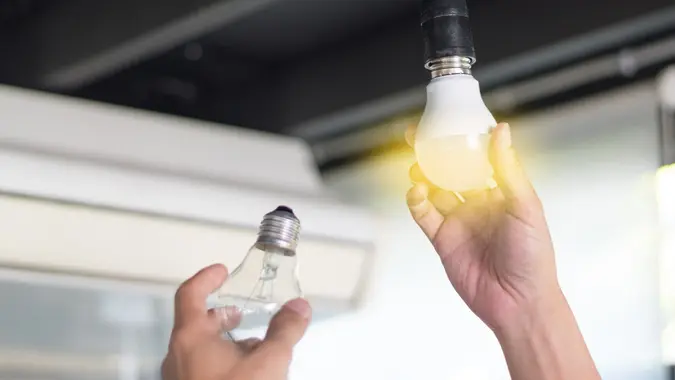
Lighting upgrades remain one of the easiest wins. By switching your lightbulbs, you can save a decent chunk of money on energy bills.
David Borchardt, P.E., Senior Mechanical Engineer at MD Energy Advisors, said switching to LED bulbs is a small but mighty move.
“Replacing one 60-watt bulb with an 8-watt LED one uses 85% less energy,” he elaborated. If you replace all the bulbs in your house, it could save several hundred dollars a year depending on your energy cost.”
3. Smart Heating Tweaks
Experts also recommend other small maintenance tasks that will save you money. These steps don’t take a lot of time at all.
One example Caviness recommended was adjusting the temperature of your hot water heater down to 120 degrees.
“The slight drop in temperature makes a negligible difference in your shower temps, and it saves a lot of energy,” he said.
Borchardt corroborated that it’s worth checking water heaters are set at a higher temperature, but no hotter than necessary.
“Most gas water heaters are set to 140 degrees,” he said. “Every 10-degree reduction in temperature can save up to 5% on gas water heating costs.”
The Common Outlier?
Both experts above mention that solar panels are fine, but it’s not a useful investment if you skip the basics. While, yes, they are a great investment in the long run, you’re still using more energy than necessary if you haven’t properly insulated the home, or plugged in any leaks.
Once you’ve addressed these foundational energy issues, you can consider budgeting for solar panels or other eco-friendly upgrades you feel are worth it.
More From GOBankingRates