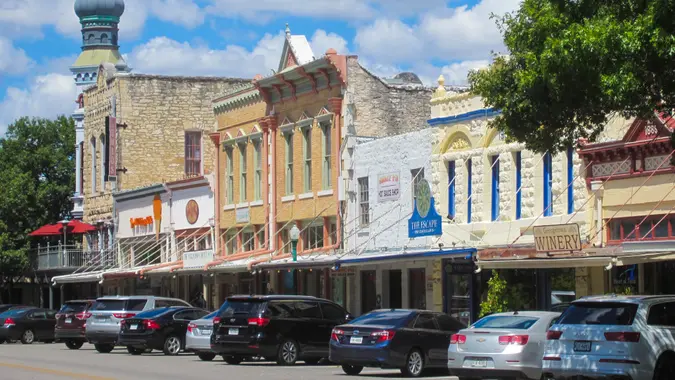
10 Cities Where Entry-Level Paychecks Are Rising Fast
 Written by
Kristopher Kane
Written by
Kristopher Kane
 Edited by
Molly Sullivan
Edited by
Molly Sullivan

Commitment to Our Readers
GOBankingRates' editorial team is committed to bringing you unbiased reviews and information. We use data-driven methodologies to evaluate financial products and services - our reviews and ratings are not influenced by advertisers. You can read more about our editorial guidelines and our products and services review methodology.

20 Years
Helping You Live Richer

Reviewed
by Experts

Trusted by
Millions of Readers
Younger professionals have had to deal with a tough and unpredictable post-pandemic employment sector. It’s a tight job market with fewer entry-level roles, and there’s new competition in the form of AI-powered automation and displaced experienced workers vying for the same entry-level positions. Ongoing economic uncertainty is causing many companies to hire at a slower, lower rate. Coupled with “the great freeze” that has seen companies reluctant to hire, fire or promote and the all-but-ubiquitous AI screening of job applicants, many feel stuck in stagnant positions but unable to leave them for greener pastures.
But for many younger workers, especially those poised to relocate to pursue more lucrative roles, there is some light in the eastern sky. According to recent research conducted by Glassdoor, pay increases for young workers are expected to outpace inflation for the first time since 2020, which may lead to many millennial and Gen Z workers having increased spending power, which will come as a significant relief for those who feel like they can’t move forward in life or in their careers.
But there’s one significant caveat. If you want to take advantage of this emerging trend, you may have to abandon large urban hubs in favor of smaller, but up-and-coming, cities.
10 Best Cities for Early Career Salary Growth
| Rank | City | Annual Growth | Average 2025 Salary | Key Growth Sectors |
| 1 | Provo, Utah | 7.0% | $61,164 | Research, Project Management, HR |
| 2 | Boise, Idaho | 5.5% | $60,876 | Healthcare, Manufacturing, Business |
| 3 | Orlando, Florida | 5.4% | $55,782 | Manufacturing, Science, Customer Support |
| 4 | Charleston, South Carolina | 5.3% | $59,100 | Healthcare, Sales, Manufacturing |
| 5 | Austin, Texas | 5.2% | $71,808 | Legal, Research, Customer Support |
| 6 | Miami | 5.2% | $62,970 | Consulting, Marketing, Customer Support |
| 7 | Rochester, New York | 5.2% | $58,513 | Healthcare, Engineering, Sales |
| 8 | Denver | 5.1% | $73,711 | Consulting, Project Management |
| 9 | Richmond, Virginia | 5.1% | $63,071 | Finance, Sales, Project Management |
| 10 | Tucson, Arizona | 5.1% | $59,975 | Engineering, Healthcare, Retail |
What Makes These Cities So Good for Young Professionals?
The common thread in many of these top 10 is diversified, local demand. In places like Boise, Charleston and Rochester, healthcare is the primary driver of economic growth. Healthcare and private education accounted for 56% of all job growth between 2023 and 2025. Because so many of these roles are both essential and highly location-dependent, employers have had to raise wages to attract young talent to these growing metro areas.
In places like Austin and Miami, most growth is due to a notable surge in “service-adjacent” professional roles like legal support, consulting and higher-end customer support. As more businesses migrate to these tax-friendly states, they’re bringing intact and high-paying corporate infrastructures with them.
How To Make the Most of These Opportunities
There may be greater opportunities on these roads less traveled, which will no doubt be a relief to many younger professionals, but capitalizing on them may require a shift in thinking. To take advantage of the potential in these smaller and perhaps less-storied cities, focus on your strengths while thinking carefully about the metric you use to gauge success.
Professionals who already work in healthcare or skilled manufacturing may have the greatest leverage, but there are still plenty of roles for technical workers. If you’re in a lower-paying sector like retail or service, consider upskilling into areas like tech sales or project coordination. At the same time, consider the cost of living as a prime criterion for comparison. You can live better in Denver on that $73,711 average salary than you could in San Francisco at double the compensation, and that should be a significant factor for anyone considering their options in the 2026 job market.
More From GOBankingRates