How Shrinkflation Is Showing Up on Dollar Tree Shelves (And Quietly Costing You Money)
 Written by
Stephanie Mickelson
Written by
Stephanie Mickelson
 Edited by
Zuri Anderson
Edited by
Zuri Anderson
Commitment to Our Readers
GOBankingRates' editorial team is committed to bringing you unbiased reviews and information. We use data-driven methodologies to evaluate financial products and services - our reviews and ratings are not influenced by advertisers. You can read more about our editorial guidelines and our products and services review methodology.

20 Years
Helping You Live Richer

Reviewed
by Experts

Trusted by
Millions of Readers
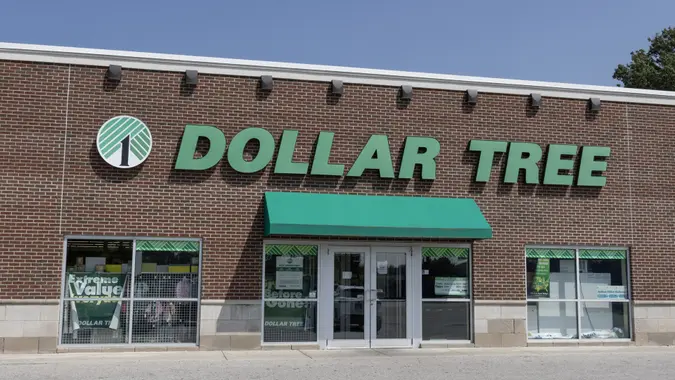
Dollar Tree has long been known as the store where everything is $1. But that changed in 2019 when the company rolled out Dollar Tree Plus! Offerings which brought in items priced between $3 and $5. In 2022, prices on all items went up to at least $1.25, the company’s first price change in over 36 years.
Now when you walk into a Dollar Tree store, you’ll not only see items priced at $1.25, $3, and $5, you’ll also see items priced much higher. These are pretty obvious changes, but what you may not notice is the shrinkflation that might be happening in plain sight. Here’s how.
What Is Shrinkflation?
According to Stephen Miller, professor of economics at University of Nevada, Las Vegas Lee Business School and research director of the university’s Center for Business and Economic Research, shrinkflation is simply defined as “raising the price of a good by lowering the amount of the good in the package.”
What this looks like in practice is that an item’s price won’t change, but it will come with fewer items in the package or a reduced weight.
How Shrinkflation Is Showing Up at Dollar Tree
Shrinkflation at Dollar Tree can be hard to spot. The prices are low as it is, so it’s common to grab what you need and move on. This is especially true if you’re not in the habit of noticing how many ounces or items are in a package.
While this practice isn’t unique to Dollar Tree, it’s easy for it to go unnoticed when prices are already so low, but as Cody Schuiteboer, president and CEO of Best Interest Financial, points out, “A price change from $1 to $1.25 to $1.50 is a 50% price increase.”
“Consumers,” he added, “are far more likely to notice a price change than a size change.”
As a result, the best approach to shopping Dollar Tree shelves, or any shelves for that matter, is to focus on the unit price of the product. Miller recommends checking the number of ounces or other measures of quantity because, “If the quantity goes down and the dollar price stays the same, then the price per unit of the good goes up.”
Keeping an eye on how shrinkflation is affecting Dollar Tree prices is a good way to make sure you’re sticking to your budget and not paying more than you want for any given product.
More From GOBankingRates