Stock Market Crash: What It Is and What Investors Should Know
 Written by
Karen Doyle
Written by
Karen Doyle
 Edited by
Joe Evans, CFHC™
Edited by
Joe Evans, CFHC™

Commitment to Our Readers
GOBankingRates' editorial team is committed to bringing you unbiased reviews and information. We use data-driven methodologies to evaluate financial products and services - our reviews and ratings are not influenced by advertisers. You can read more about our editorial guidelines and our products and services review methodology.

20 Years
Helping You Live Richer

Reviewed
by Experts

Trusted by
Millions of Readers
A stock market crash is a sudden and significant decline in stock prices across major indexes. These events often happen quickly and can wipe out trillions of dollars in market value in a short period of time.
Crashes are typically driven by a combination of economic stress, investor panic and financial instability. While they can be alarming, market crashes are not unusual in long-term investing history. Understanding what causes a crash — and how investors typically respond — can help put market volatility into perspective.
According to the U.S. Securities and Exchange Commission, market fluctuations are a normal part of investing, even during periods of long-term growth.
At a Glance: Stock Market Crash Basics
Feature Details Definition Rapid and widespread decline in stock prices Typical threshold Often a drop of 20% or more Common triggers Economic crises, interest rate shocks, financial instability Impact Large losses in stock market value Recovery Can take months or years The Federal Reserve notes that financial markets periodically experience major downturns as part of economic cycles.
What Is a Stock Market Crash?
A stock market crash occurs when stock prices fall sharply across major markets in a short period of time. While there’s no strict definition, many analysts consider a crash to be a rapid drop of 20% or more in major stock indexes.
Crashes often happen when investor confidence suddenly disappears. When large numbers of investors try to sell assets at the same time, prices can fall rapidly.
The U.S. Securities and Exchange Commission explains that market volatility is often driven by shifts in investor expectations and economic conditions.
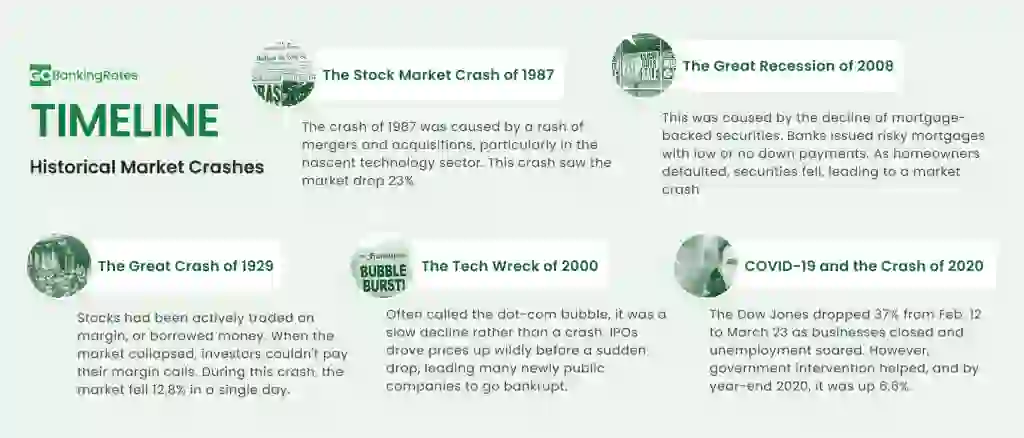
Major Stock Market Crashes in History
Looking at past market crashes can help investors understand how markets behave during periods of extreme volatility.
| Crash | Year | Key Cause |
|---|---|---|
| Wall Street Crash | 1929 | Speculation and economic collapse |
| Black Monday | 1987 | Computerized trading and panic selling |
| Dot-com Crash | 2000 | Tech stock bubble burst |
| Financial Crisis | 2008 | Housing market collapse |
| COVID Market Crash | 2020 | Global economic shutdown |
What Causes a Stock Market Crash?
Market crashes rarely have a single cause. Instead, they usually result from several economic and financial pressures happening at once.
Economic Recession
Economic slowdowns can reduce corporate profits and investor confidence. When businesses earn less money, stock prices often fall. The Federal Reserve monitors economic indicators that often influence financial markets.
Asset Bubbles
Crashes often occur after asset bubbles form. A bubble happens when prices rise far above the underlying value of an asset. When investors realize the prices are unsustainable, rapid selling can trigger a market collapse.
Interest Rate Shocks
Rapid increases in interest rates can affect stock markets. Higher borrowing costs reduce business investment and consumer spending. The Federal Reserve uses interest rates to influence economic activity, which can affect stock prices.
Investor Panic
Psychology plays a major role in financial markets. When investors panic and begin selling, declines can accelerate quickly. Automated trading systems and large institutional investors can amplify market movements.
According to the Financial Industry Regulatory Authority, emotional reactions to market volatility often lead to poor investment decisions.
How Long Do Market Crashes Last?
The duration of a crash varies depending on economic conditions. Some recoveries happen quickly, while others take years.
| Example | Recovery Time |
|---|---|
| 1987 crash | Less than 2 years |
| 2000 dot-com crash | About 7 years |
| 2008 financial crisis | About 4 years |
| 2020 COVID crash | Several months |
Historically, markets have recovered and eventually reached new highs after major downturns. Long-term data from the S&P Dow Jones Indices shows the U.S. stock market has delivered positive long-term returns despite short-term crashes.
What Investors Often Do During a Market Crash
When markets decline sharply, investors typically respond in several ways.
Long-Term Investors Stay Invested
Many financial professionals recommend maintaining a long-term perspective. Selling during a crash can lock in losses. According to the Vanguard Group, maintaining a diversified long-term portfolio can help investors weather market downturns.
Some Investors Buy During Crashes
Market downturns can create buying opportunities. Stocks may trade at lower prices relative to long-term value. However, predicting the bottom of a market crash is extremely difficult.
Diversification Becomes More Important
Diversified portfolios may reduce risk during market declines. Investments across multiple asset classes can help stabilize portfolio performance. Morningstar highlights diversification as a key strategy for managing market volatility.
Warning Signs of a Possible Market Crash
While crashes are difficult to predict, several conditions sometimes appear beforehand. Common warning signals include:
- Rapid asset price increases
- High market speculation
- Rising interest rates
- Weak economic growth
- Financial system stress
Even with these indicators, timing a market crash is extremely difficult.
Quick Decision Guide
Market dropping quickly? Avoid panic selling if you’re investing long-term.
Holding diversified investments? Maintain portfolio balance during volatility.
Trying to predict crashes? Focus on a long-term investment strategy instead.
Final Take to GO
A stock market crash is a rapid decline in stock prices driven by economic pressure, investor panic or financial instability. While crashes can be unsettling, they are a recurring part of financial markets.
For long-term investors, understanding market cycles and maintaining a disciplined investment strategy may help reduce the impact of short-term volatility.
History shows that markets have consistently recovered from past crashes — even after severe downturns.
FAQ
Stock market crashes can create uncertainty for investors. Here are answers to common questions about how they work.- What qualifies as a stock market crash?
- A crash typically refers to a rapid decline in stock prices across major indexes, often exceeding 20%.
- How often do stock market crashes happen?
- Major crashes are relatively rare, but markets experience corrections and downturns periodically.
- What causes a stock market crash?
- Crashes can result from economic recessions, asset bubbles, financial instability or sudden shifts in investor sentiment.
- Can the stock market recover after a crash?
- Historically, stock markets have recovered after major downturns and eventually reached new highs.
- Should investors sell during a market crash?
- Many financial professionals recommend maintaining a long-term strategy instead of reacting to short-term volatility.
- How can investors prepare for market crashes?
- Diversification, long-term planning and maintaining an emergency fund can help reduce financial risk during market downturns.
John Csiszar contributed to the reporting for this article.
Data is accurate as of March 16, 2026, and is subject to change.
Our in-house research team and on-site financial experts work together to create content that’s accurate, impartial, and up to date. We fact-check every single statistic, quote and fact using trusted primary resources to make sure the information we provide is correct. You can learn more about GOBankingRates’ processes and standards in our editorial policy.
- U.S. SEC "Financial Navigating in the Current Economy: Ten Things to Consider Before You Make Investing Decisions"
- Congress.gov "Common Causes of Economic Recession"
- U.S. SEC "How Should I Know? Lack of Confidence Biases Stock Market Expectations Toward Zero"
- Harvard University "Stock-Market Crashes and Depressions"
- U.S. Federal Reserve "How We Promote Financial Stability"
- U.S. Federal Reserve "Economy at a Glance - Policy Rate"
- FINRA "Investor Tips for Turbulent Markets"
- CNBC "S&P 500 closes flat, rebounding from lows as traders buy the dip after U.S.-Iran attacks: Live updates"
- Vanguard "Why is diversification important in an investment portfolio?"
- Morningstar "Morningstar’s Guide to Portfolio Diversification"