Is Venmo Safe? Security, Scams and How To Protect Yourself
 Written by
Rudri Bhatt Patel, CFHC™
Written by
Rudri Bhatt Patel, CFHC™
 Edited by
Joe Evans, CFHC™
Edited by
Joe Evans, CFHC™
Commitment to Our Readers
GOBankingRates' editorial team is committed to bringing you unbiased reviews and information. We use data-driven methodologies to evaluate financial products and services - our reviews and ratings are not influenced by advertisers. You can read more about our editorial guidelines and our products and services review methodology.

20 Years
Helping You Live Richer

Reviewed
by Experts

Trusted by
Millions of Readers
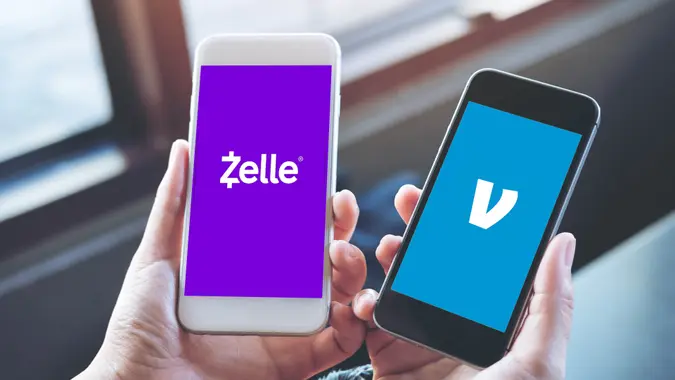
If you’re asking, “Is Venmo safe?”, you’re not alone. Millions of Americans use Venmo to split rent, pay friends and send money instantly. But safety depends on how you use it.
Short answer: Venmo is secure as a platform, but it’s not scam-proof.
Venmo uses encryption and fraud monitoring, but peer-to-peer payments carry risk — especially when sending money to people you don’t know.
Let’s break it down:
Is Venmo Safe? At a Glance
Question Short Answer Is Venmo encrypted? Yes Is Venmo FDIC insured? In certain cases Can Venmo payments be reversed? Sometimes Are scams common? Yes Is it safe to send money to strangers? No
How Secure Is Venmo?
Venmo is owned by PayPal and uses a similar security infrastructure. According to Venmo’s official disclosures:
- Data is encrypted in transit
- Transactions are monitored for suspicious activity
- Multi-factor authentication is available
- Biometric login (Face ID/fingerprint) can be enabled
This means hackers can’t easily intercept transactions. However, most Venmo fraud happens through social engineering, not hacking.
Is Venmo FDIC Insured?
Venmo itself isn’t a bank. However, funds stored in eligible Venmo accounts may be covered by pass-through FDIC insurance through partner banks, subject to limits and eligibility rules.
The Federal Deposit Insurance Corporation states that pass-through coverage applies only if certain recordkeeping requirements are met.
Important:
- FDIC insurance protects against bank failure.
- It doesn’t protect you if you send money to a scammer.
Common Venmo Scams
According to the Federal Trade Commission, peer-to-peer payment apps are frequently used in fraud schemes.
1. Accidental Payment Scam
A stranger sends you money and asks for it back. The original payment later reverses.
2. Impersonation Scam
Scammers pose as Venmo support and request verification codes.
3. Marketplace Overpayment
A buyer overpays and asks for a refund difference.
4. Romance or Emergency Scams
Fraudsters build trust before requesting money. The FTC reports billions of dollars lost annually to fraud, with payment apps increasingly cited in complaints.
Is Venmo Safe for Large Payments?
Venmo is designed for:
- Splitting bills
- Paying friends
- Everyday small transfers
It may not be ideal for:
- Large purchases from strangers
- Rental deposits
- Vehicle sales
Payments sent as peer-to-peer transfers often have limited buyer protection under Venmo’s user agreement.
Venmo vs Other Payment Methods
| Feature | Venmo | Credit Card | Bank Transfer |
|---|---|---|---|
| Encryption | Yes | Yes | Yes |
| Chargeback rights | Limited | Strong | Limited |
| Scam risk | Moderate | Lower (with protections) | Lower for known parties |
| FDIC protection | Limited/pass-through | N/A | Yes |
Credit cards generally provide stronger dispute protections under federal law.
How To Use Venmo Safely
To reduce risk:
- Only send money to people you know
- Set transactions to “Private”
- Enable multi-factor authentication
- Never share verification codes
- Avoid storing large balances
- Transfer funds to your bank regularly
The Consumer Financial Protection Bureau advises treating peer-to-peer apps like cash — once sent, funds may be difficult to recover.
What Venmo Doesn’t Guarantee
Venmo generally doesn’t guarantee reimbursement if:
- You authorize a payment to a scammer
- You sent money to the wrong person
- You regret a peer-to-peer transfer
Buyer protection applies primarily to eligible business transactions, not personal transfers.
Final Take: Is Venmo Safe?
Yes — Venmo is technically secure and widely used. But safety depends on behavior.
Venmo is safest when:
- You send money only to trusted contacts
- You enable all security settings
- You avoid large transactions with strangers
If you need stronger protections, consider using a credit card or traditional bank transfer instead.
FAQ
Although Venmo is convenient, users often have questions about safety and fraud. Here are answers to the most common questions about whether Venmo is safe.- Is Venmo safe to use?
- Venmo uses encryption and fraud monitoring, making it secure as a platform. However, users can still fall victim to scams if they send money to unknown individuals.
- Is Venmo safer than cash?
- Venmo provides transaction records and security tools, while cash cannot be digitally hacked. Each has different risks.
- Can Venmo payments be reversed?
- Some payments may be disputed or reversed, particularly in cases of unauthorized activity or fraud.
- Is money in Venmo FDIC insured?
- Funds may be eligible for pass-through FDIC insurance through partner banks, but this does not protect against scams.
- Should I keep a large balance in Venmo?
- It is generally safer to transfer funds to your bank rather than store large amounts in payment apps.
- What is the safest way to use Venmo?
- Only send money to trusted contacts, enable multi-factor authentication and keep your transaction history private.
Information is accurate as of Feb. 12, 2026.
Editorial Note: This content is not provided by any entity covered in this article. Any opinions, analyses, reviews, ratings or recommendations expressed in this article are those of the author alone and have not been reviewed, approved or otherwise endorsed by any entity named in this article.
Our in-house research team and on-site financial experts work together to create content that’s accurate, impartial, and up to date. We fact-check every single statistic, quote and fact using trusted primary resources to make sure the information we provide is correct. You can learn more about GOBankingRates’ processes and standards in our editorial policy.
- Venmo "Website"
- Venmo "Login Security"
- Venmo "Buyer/Seller Protections"
- Federal Deposit Insurance Corporation "Deposit Insurance"
- Venmo "Common Scams on Venmo"
- Consumer Financial Protections Bureau "Consumer advisory: Your money is at greater risk when you hold it in a payment app, instead of moving it to an account with deposit insurance"
- FDIC "Pass-through Deposit Insurance Coverage"
- Federal Trade Commission "Avoiding and Reporting Scams"
- Venmo "User Agreement"